
21 min read
Sales reps rarely have enough time to give every prospect on a list the same attention. Some numbers produce live conversations week after week. Others eat up dial time and return nothing but voicemail, ringing, or a stranger who has never heard of the person you asked for.
Most teams know this from experience. Few have a reliable way to know which prospects to call first before the rep starts dialing.
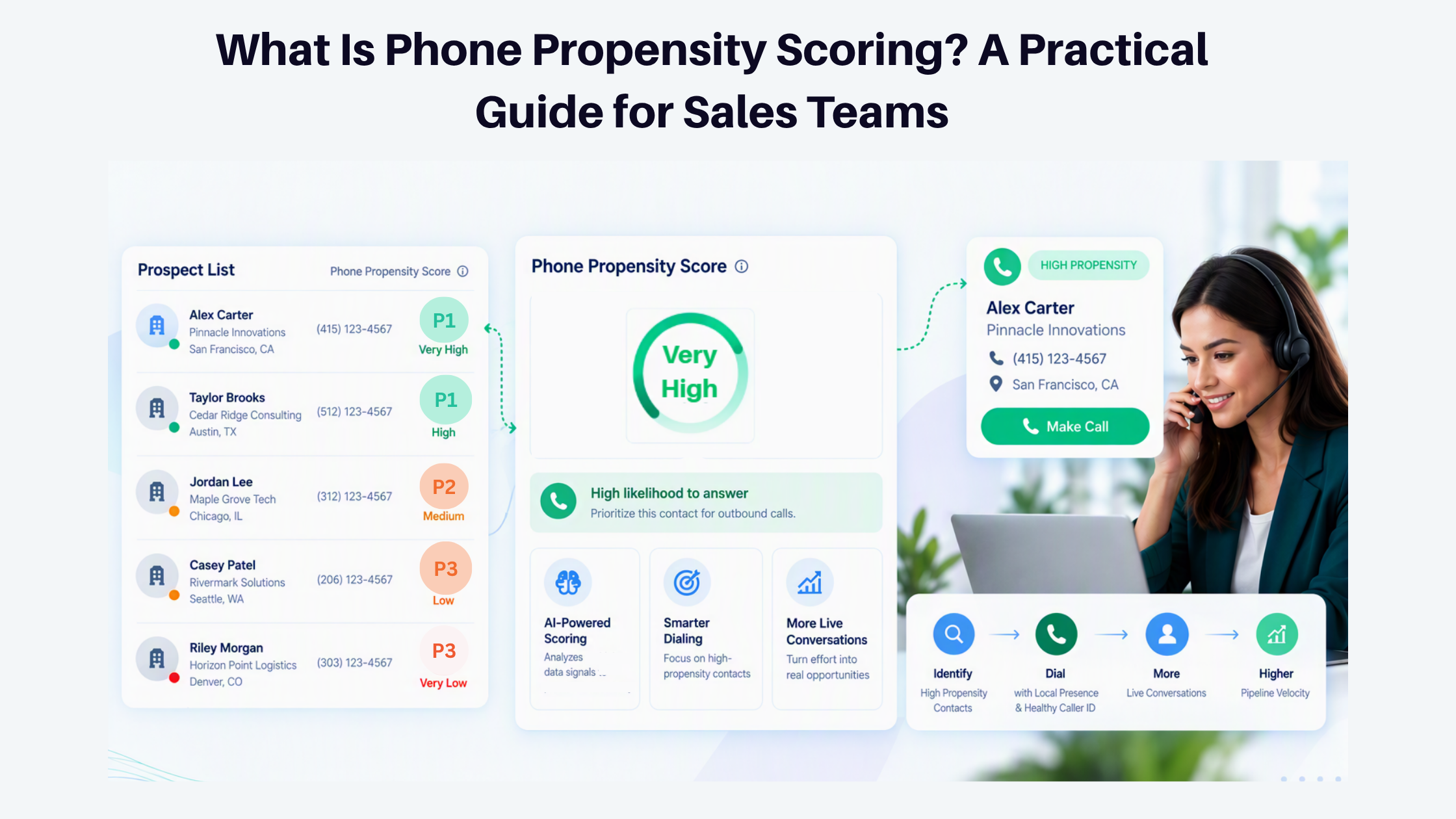
Phone propensity scoring gives them that way. It changes the question a rep asks before a calling block. Instead of "Who is on my list?", the rep asks "Who on my list is most likely to answer?"
This guide covers what phone propensity scoring is, what it measures, how it compares to lead scoring, how to prioritize a cold calling list with it, and what to look for in phone propensity scoring software.
Key Takeaways:
-
Phone propensity scoring predicts how likely a prospect's phone number is to produce a live answer.
-
In Koncert Data Researcher, P1 records average about 1 live answer per 4 dials, P2 about 1 per 15, and P3 about 1 per 25.
-
A number that answers is not proof the right person answers. Contact verification is a separate step.
-
Scored lists work with the CRM and dialer your team already uses.
What Is Phone Propensity Scoring?
Phone propensity scoring is a method of grading prospect phone numbers based on their observed likelihood of producing a live answer. Sales teams use the score for sales prospect prioritization: they call higher-propensity prospects first and spend less time on records that rarely pick up.
If you have heard the term "propensity model" in sales, this is the same idea applied to one behavior. A propensity model predicts the likelihood of a specific action, such as buying, churning, or opening an email. Phone propensity scoring predicts one action: answering the phone. That makes it the most direct answer to a question every SDR manager asks, which is how to know which prospects will answer the phone.
The score does not predict whether the prospect will buy, book a meeting, or even be interested. That narrow focus is the point. Calling is the most time-expensive activity in outbound, and a live answer is the first thing that has to happen before any sales conversation can start.
Most sales teams already score leads. Marketing automation platforms and CRMs assign points for job title, company size, website visits, and email engagement. Those scores help decide which accounts deserve attention. They say nothing about whether the phone will ring through to a person.
Here is the simplest way to separate the two:
-
Lead scoring asks: How valuable might this prospect be?
-
Phone propensity asks: How likely is someone to answer this number?
A rep with a list of 800 well-qualified VPs of Sales still has to pick an order to call them in. Phone propensity scoring gives them that order.
Why Sales Teams Shouldn't Treat Every Prospect the Same
Open any prospect list your team worked last quarter and you will find records that behave very differently when dialed. A typical list contains:
-
Prospects who answer their phone often
-
Prospects who almost never answer
-
Wrong or outdated numbers
-
Contacts who have left for another company
-
Company switchboards and other numbers that don't ring directly to the prospect
Every one of those records can look valid in the CRM. It has a name, a title, a company, and a phone number in the right format. Nothing on the screen tells the rep that record #212 reaches a person 1 time in 4 while record #213 reaches no one 1 time in 25.
A list can contain thousands of valid-looking records without every record being equally useful for outbound calling.
1,000 prospects are not 1,000 equal calling opportunities
Consider a hypothetical list of 1,000 prospects. The split below is illustrative only. Every list is different, and the real distribution depends on the source of the data, the industry, and the seniority of the contacts.
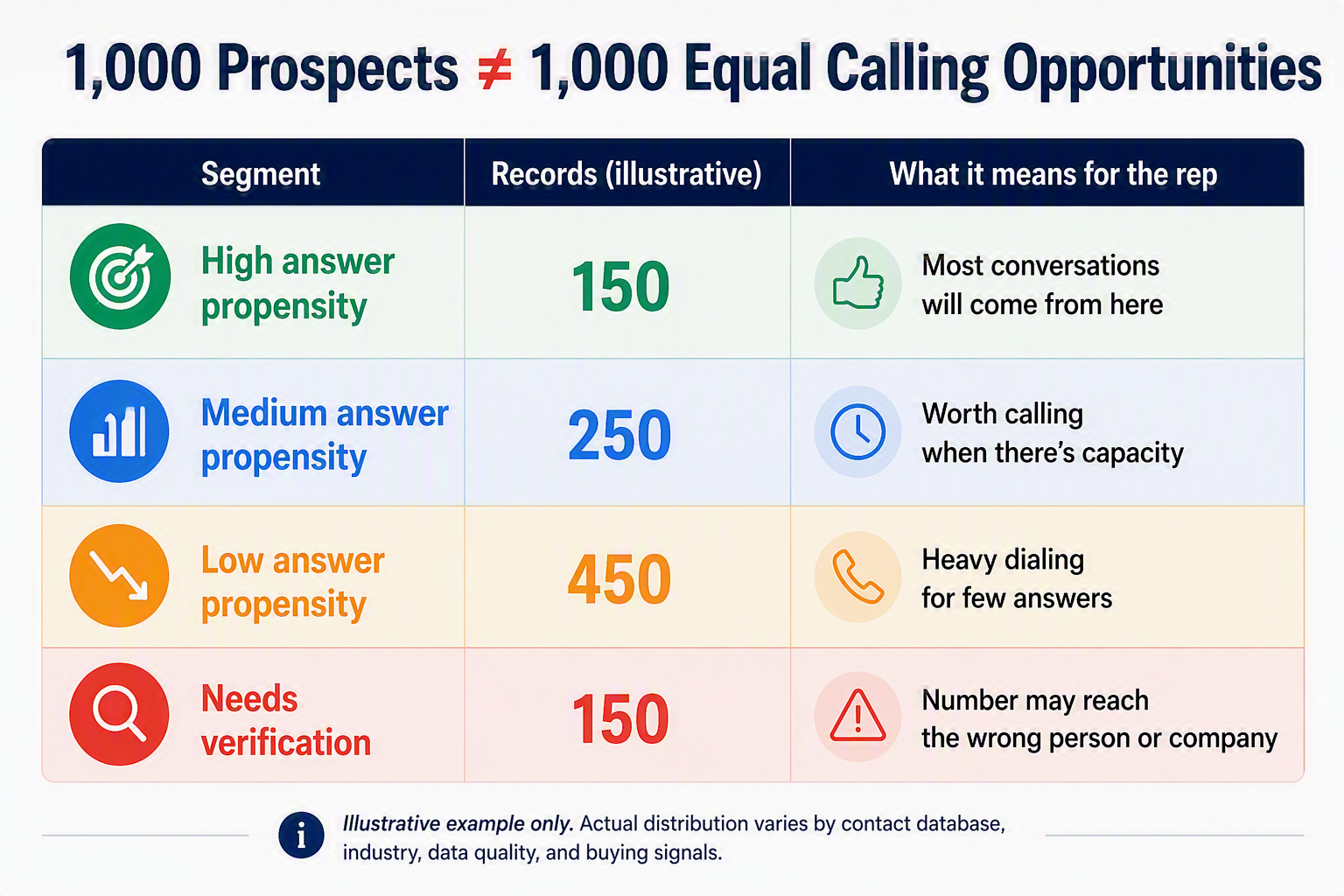
If a rep works this list top to bottom in alphabetical order, the high-propensity records are scattered evenly through it. The rep spends most of the day on the 600 records that produce the fewest conversations and reaches the productive ones by chance.
Koncert has seen this pattern on real lists. On the lists scored so far with Koncert Data Researcher, half to three-quarters of the records were not worth a dial with single-line dialing.
What Does Phone Propensity Actually Measure?
Phone propensity scoring is a form of phone number answer rate prediction. It looks at how a prospect's own phone numbers behave when called and estimates the sales call answer rate you can expect from each record. The inputs vary by provider. For Koncert Data Researcher, the system analyzes each prospect's mobile and direct phone numbers and generates a phone propensity score called the Koncert DR Score.
Company main lines are not used to grade a prospect. A switchboard might answer every call, but that tells you about the receptionist, not the VP of Operations you are trying to reach. Including main lines would inflate scores and send reps to records that don't lead to the actual contact.
The scoring breaks down into three areas.
Mobile number behavior. Does the prospect's mobile number tend to produce a live answer? Mobile numbers often perform well. In Koncert's analysis of more than 20 million calls, mobile phones connected at a 61% higher rate than office or direct lines. Still, a mobile that sits dark for months is a poor use of a rep's time.
Direct number behavior. Does the prospect's direct dial tend to produce a live answer? Many direct lines now forward to voicemail by default, especially for hybrid and remote employees. Some still ring on a desk where someone picks up.
Observed calling behavior over time. How has each number behaved across many calls? A single call tells you very little. Patterns across a long period tell you much more. Koncert's tiers come from observed behavior measured across multiple years.
The output is a prediction about answer likelihood. It is not a judgment about the prospect's value, budget, or fit. A P3 record might be your ideal customer. It just rarely answers the phone.
Phone Propensity vs. Lead Scoring: What's the Difference?
These two scores are often confused, so it helps to lay them side by side. Think of it as lead scoring vs. call prioritization: one ranks accounts, the other ranks dials.
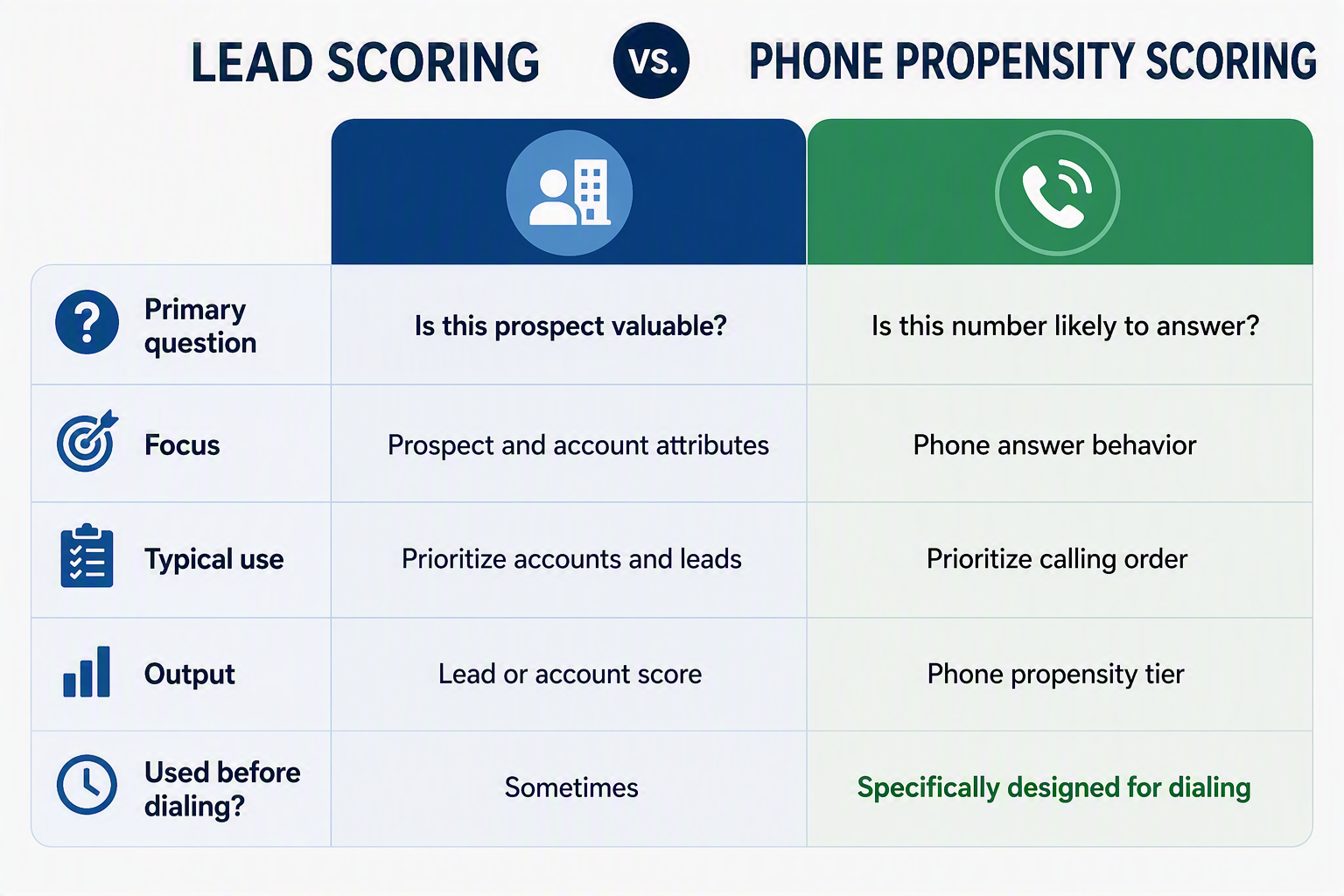
The two scores work well together. They measure different things, so a record can be strong on one and weak on the other.
-
A high-value prospect may have low phone propensity. A CFO at a target account might never answer a cold call to their mobile.
-
A lower-value prospect may have high propensity. A manager at a smaller account might answer almost every time.
Teams can combine the signals in whatever way fits their workflow.
How Phone Propensity Scoring Works
Prospect phone scoring is simple for the sales team. Most of the work happens in the background. Here is how it runs in four steps.
-
Step 1: Start with an existing prospect list. The team provides the records it already plans to work. In Koncert, you upload the list and assign it to Data Researcher. The list is locked while it's processed, so nobody dials a half-finished copy.
-
Step 2: Analyze eligible phone numbers. The system evaluates each prospect's mobile and direct numbers based on observed answer behavior.
-
Step 3: Assign a propensity tier. Each scoreable prospect lands in exactly one tier: P1 (High), P2 (Medium), or P3 (Low). If a record can't be scored, it carries no tier. Koncert doesn't give it the worst tier by default, and it doesn't use credits on records it couldn't evaluate.
-
Step 4: Prioritize the calling sequence. Results are written back to the CRM or sales engagement platform. Reps sort by score and work from the top down.
For teams using Data Researcher Premium, an extra step sits between scoring and delivery: Koncert's human agents call each record to verify who answers and where they work now. More on that below.
What Do P1, P2, and P3 Mean?
This is the part reps care about most. Each phone propensity score tier maps to an expected answer rate, based on Koncert's observed data.
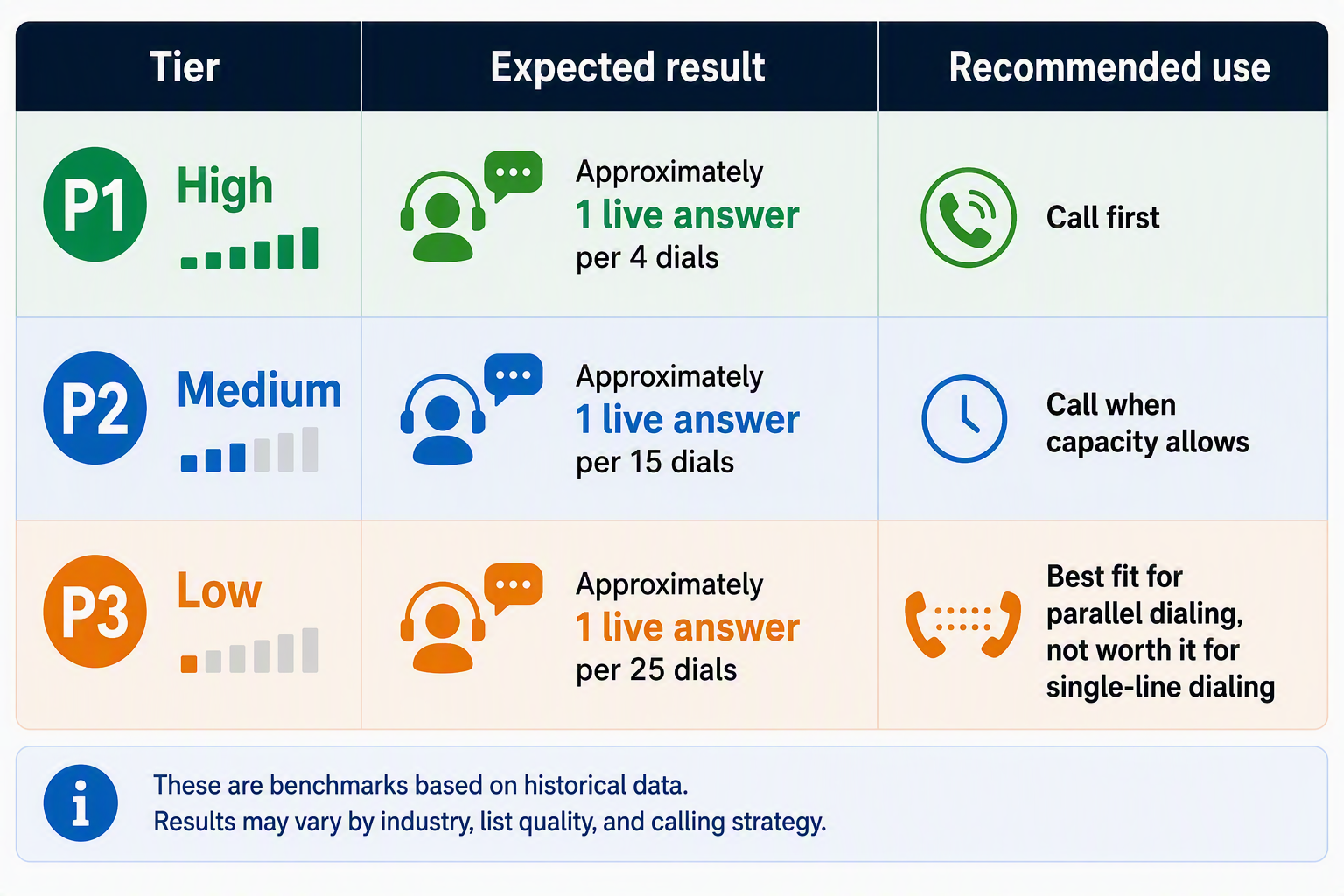
What is a good cold call connect rate?
Koncert's cold calling research puts typical cold call connect rates at 5% to 15%, depending on list quality and targeting. A P1 rate of about 1 answer per 4 dials works out to roughly 25%. A P3 rate of about 1 per 25 dials is roughly 4%, below the low end of that range.
One distinction matters here: connect rate vs. conversation rate. A connect is any live answer, including a gatekeeper or the wrong person. A conversation is a live exchange with the intended prospect. Propensity scoring predicts connects. Verification, covered below, tells you how many of those connects reach the right person.
These rates are expectations, not guarantees
The tier rates describe how numbers in each tier have behaved on average across a large volume of calls. Any single P1 record might not answer today. Any single P3 record might pick up on the first try. The value shows up across a calling block or a full list, not on an individual dial.
The distribution also varies by list. One team might get back 30% P1 records. Another might get 8%. Data source, industry, contact seniority, and how recently the list was built all affect the result. The only way to know your breakdown is to score a sample.
How to Prioritize a Cold Calling List with Phone Propensity Scores
Knowing the tier is useful only if it changes what reps do. Here are three practical approaches to cold calling list prioritization. Treat them as starting points to test and adjust.
Use case 1: Start with P1 prospects
If a rep has a two-hour calling block, spend it on P1 records first. Early conversations build momentum, surface objections the rep can practice against, and put meetings on the calendar before the day gets interrupted.
A simple rule many teams follow: don't touch P2 until the P1 records for that day's list have had at least one attempt. For more on structuring a calling block, see our cold calling tips and tricks.
Use case 2: Build a dialing strategy for each tier
Different tiers justify different dialing methods. Here is one example of a dialing strategy for mixed lists, including low connect rate lists:
-
P1: Focused single-line calling with research before each dial. These prospects are likely to answer, so the rep should be ready with account context.
-
P2: Standard outbound sequences mixing calls, email, and social touches, with calls made through the AI Power Dialer to keep pace up.
-
P3: Higher-volume or parallel dialing, where the dialer handles the low answer rate and connects the rep only when someone picks up.
P3 is where a parallel dialer for low connect rates makes the most sense. At 1 answer per 25 dials, a single-line rep spends most of their time listening to rings. A parallel dialer calling several numbers at once absorbs those unanswered calls so the rep doesn't have to. Our guide to AI parallel dialing covers how that works in practice.
Phone Propensity Isn't the Same as Contact Verification
Knowing that a number is likely to answer doesn't tell you who will answer.
A number can score P1 because someone picks up almost every time. That someone might be the prospect. It might also be the person who took over the prospect's desk, or another person who inherited the old mobile number, or the prospect's replacement after they left the company.
That's why there are two separate questions:
-
Phone propensity asks: Will anyone pick up?
-
Contact verification asks: Is it the right person, and do they still work at the company?
So what is human verification in sales? It is the most direct way to verify B2B contact information: a trained person calls the number and records who answers. For teams on Data Researcher Premium, Koncert's human agents call the prospect records and document two findings on each live call: Contact Identity and Company Identity. The agents make one call per mobile, direct, and company line. They aren't selling anything. They are confirming who answered and where that person works now.
The agents are real people. They are not AI models or AI voice agents. That separates Data Researcher Premium from a typical B2B contact verification service that checks records against databases. A live human call remains one of the most reliable ways to confirm that a record is accurate right now, since many people hang up on or ignore automated voices.
Layer one predicts. Layer two verifies identity. The two are designed to work together.
What Happens When the Wrong Person Answers?
Anyone who has cold called for more than a week has had these calls:
-
"Sorry, this is Mark. Jennifer had this extension before me."
-
"She left about six months ago."
-
"You've reached Acme Logistics, but I don't know anyone by that name."
-
A voice answers but won't confirm their name.
-
The company named in the CRM was acquired and rebranded last year.
Each of these counts as a connect in most dialer reports. None of them is a conversation with the prospect. A rep who hits five of these in a morning has spent real time and emotional energy on records that were never going to produce a meeting.
A phone number answering is not the same as the right prospect answering.
This is why answer likelihood and B2B contact data accuracy are separate dimensions of sales data quality. A list can have strong answer rates and poor accuracy. It can also be accurate and rarely answer. Teams need both signals to know where their time is going.
How the Koncert DR Score shows both
Koncert Data Researcher captures both in a single sortable column, the Koncert DR Score. On a Premium list, the score looks like P1-11:
-
P1 is the machine-generated propensity tier.
-
The first digit is contact verification.
-
The second digit is company verification.
P1-11 is the best possible record: a number that answers often, reaching the named person, at the named company. P3-43 sits near the other end: a number that rarely answers, where the agent couldn't hear a contact name, and where the prospect no longer works at the company.
That company digit is also the answer to a common question: how to tell if a contact left the company. A "3" means a human agent confirmed on a live call that the prospect has moved on.
The digits run best to worst, so sorting the column puts the best records first in any spreadsheet, CRM, or dialer without a custom formula. On a Data Researcher Pro list, which has no human verification, the score is just the tier, such as P1.
If verification shows a record has gone stale, the next step is finding a current number for the right contact. That is the job of Waterfall Data Enrichment, which checks multiple data providers in sequence to fill in missing or outdated phone numbers. Our guide to waterfall enrichment explains how the two steps differ.
How Phone Propensity Can Improve Cold Call Connect Rates
It's worth being specific about what phone propensity scoring does and doesn't do. It won't make an unqualified prospect buy. It won't fix a weak opener or a poor offer. What it does is change where reps spend their dialing time. For teams asking how to improve cold call connect rates without buying more data, that shows up in five practical ways.
Less time on low-propensity records. Reps stop working lists alphabetically or by import date and start with records that have the best expected answer rate.
Better use of the lists you already have. Many teams respond to low connect rates by buying more data. Scoring the existing list often shows that the problem is call order, not list size.
More informed dialer workflows. Tiers give managers a clear basis for routing records to single-line, power, or parallel dialing across the Koncert dialer suite.
Visibility into poor-quality records. Stop-calling recommendations and verification results show exactly which records are dead ends and why. That feeds back into decisions about data sources.
Focus on prospects likely to pick up. Reps spend more of each calling block in live conversations, which is where they build skill and pipeline.
All five add up to better sales dialing efficiency. Koncert positions the value of Data Researcher around three things: prioritizing higher-value prospects, avoiding low-value records, and improving dial-to-conversation rate. Meetings and revenue still depend on the rep, the message, and the market. A better call order gives the rep more chances to make those count.
How to Add Phone Propensity Scoring to Your Existing Sales Process
You don't need a new tech stack to start. Here's a checklist teams can use.
Before calling: how to clean a prospect list
-
Export or identify the list your team plans to work next.
-
Score the eligible phone numbers.
-
Separate records into P1, P2, and P3.
-
Flag records that need verification, especially high-value accounts where accuracy matters most.
-
Pull stop-calling records out of the active calling list.
During calling
-
Start with the highest-priority records.
-
Track live conversations separately from connects. A gatekeeper or wrong person is a connect, not a conversation.
-
Watch connect behavior by tier. If P1 records are underperforming on your list, look at time of day and caller ID reputation. Calling windows vary by industry; our piece on reaching C-suite prospects covers timing patterns by role and sector.
-
Adjust the dialing strategy. Move P3 records to parallel dialing if single-line results confirm the low answer rate.
After calling
-
Feed verified findings back into the CRM.
-
Review records marked as the wrong contact and decide whether to research a replacement.
-
Act on job changes. A prospect who moved to a new company might be a warm lead there, and their old account needs a new contact.
-
Use tier results to shape future lists and evaluate data sources.
A note on caller ID: propensity scoring tells you who is likely to answer, but spam labels on your outbound numbers can still suppress answer rates. Teams that care about connect rates should pair scoring with Fully Managed Caller ID Health or a similar approach to number reputation. Our article on how caller ID affects cold call success goes into more detail.
What to Look for in Phone Propensity Scoring Software
If you are comparing phone propensity scoring software, a prospect list scoring tool, or call list prioritization software, these questions separate useful products from generic lead scores:
-
Does it score the prospect's own lines? Scores that include switchboards measure the receptionist. Ask which numbers feed the score.
-
Do tiers map to expected answer rates? "High, medium, low" is only useful if each label comes with a rate you can plan around.
-
Does it overwrite your CRM data? Scores should land in their own field. Your existing records should stay untouched.
-
Are you charged for records it can't score? Unscoreable records should carry no tier and no cost.
-
Can it verify contacts, not just score them? A sales data verification service that confirms identity by live call answers a different question than a score does.
-
Does it work with the dialer you already use? A sortable field should load into any dialer without a new workflow.
-
Can you test it on your own data first? A sample of your list tells you more than any vendor benchmark.
How Koncert Data Researcher Applies Phone Propensity Scoring
Koncert Data Researcher combines four pieces into one workflow:
-
Phone Propensity Scoring: every scoreable prospect graded P1, P2, or P3 based on how their own mobile and direct lines behave.
-
Human Verification (Premium): Koncert agents make human verification calls on your sales list and document Contact Identity and Company Identity, so you get human-verified contact data.
-
CRM and SEP write-back: results go back into the systems your team already uses, including prospect lists inside Koncert.
-
Prioritized lists: reps sort and filter by the Koncert DR Score and call from the top.
A few design choices matter for teams worried about data quality:
-
Koncert adds and doesn't overwrite. The DR Score goes into its own column. Existing prospect data stays as it was.
- Job changes are flagged, not edited. When a contact has moved, the finding says so. The decision to update the record stays with your team.
-
No score, no credit. Records Koncert couldn't evaluate carry no tier and use no credits.
Data Researcher Pro vs. Premium
|
Feature |
Pro |
Premium |
|
Phone Propensity Scoring |
Yes |
Yes |
|
Stop-Calling Recommendations |
Yes |
Yes |
|
Human Verification Calls |
No |
Yes |
|
Contact and Company Verification |
No |
Yes |
Pro is the fastest way to see which prospects to call first. Premium adds human verification and uses additional credits.
Scored lists work with the dialer you already run. Reps can load the prioritized list into the AI Parallel Dialer, AI Power Dialer, or Koncert Phone and work it in tier order.
Frequently Asked Questions
What is phone propensity scoring?
Phone propensity scoring grades prospect phone numbers by how likely they are to produce a live answer, based on observed calling behavior. Sales teams use it to decide which prospects to call first.
How is phone propensity different from lead scoring?
Lead scoring estimates how valuable a prospect might be. Phone propensity estimates how likely someone is to answer their number. The two measure different things and work well together.
How do I prioritize a cold calling list?
Score the list by answer likelihood, call high-propensity records first, route low-propensity records to parallel dialing, and remove records flagged as incorrect. Combine the phone score with lead or account value if you have it.
What does a P1 phone propensity score mean?
P1 means high propensity. In Koncert Data Researcher, P1 records typically produce about 1 live answer for every 4 dials. Reps should call these first.
What does P2 mean?
P2 means medium propensity, with about 1 live answer for every 15 dials. These are worth calling when the rep has capacity after working P1 records.
What does P3 mean?
P3 means low propensity, with about 1 live answer for every 25 dials. These records are a better fit for parallel dialing than single-line dialing.
How can I improve cold call connect rates?
Call high-propensity records first, keep caller IDs clean, dial from local numbers, favor mobile and direct lines, and stop calling records with very low connect history.
Does phone propensity scoring guarantee someone will answer?
No. The tier rates are expected averages based on observed behavior. Individual calls will vary, and the distribution of tiers differs from list to list.
Does phone propensity scoring verify the contact?
No. Propensity predicts whether anyone will answer. It doesn't confirm who answers. Contact verification requires a separate step, such as a live call by a human agent.
Can a prospect have high propensity but still be the wrong contact?
Yes. A number can answer reliably and still reach a colleague, a replacement, or someone at a different company. That's why Koncert offers human verification as a second layer.
Can phone propensity scoring work with Salesforce, HubSpot, or my existing CRM?
Yes. Koncert Data Researcher writes the DR Score back into your CRM or sales engagement platform in its own column, without overwriting existing data. Koncert integrates with CRMs and SEPs including Salesforce, HubSpot, Salesloft, and Outreach.
Can phone propensity scoring work with an existing sales dialer?
Yes. The score is a sortable column, so reps can load the prioritized list into any dialer and call in tier order.
For more questions about Koncert's platform, visit the Koncert FAQ page.
Conclusion: Prioritize the Call Before You Make It
Sales teams don't have to treat every record on a prospect list as an equal calling opportunity. Phone propensity scoring adds a signal most lists lack: how likely a number is to produce a live answer. Used with lead and account data, it helps reps decide where to spend limited dialing time first, and which records to stop calling.
Koncert Data Researcher combines phone propensity scoring with optional human verification. Teams get a prioritized list, a named stop-calling list, and a clear record of who actually answered and where they work now.
Talk to a Koncert representative