

13 min read
Top Cold Call Objection Handling Techniques for B2B Reps
By: Koncert Marketing on Jun 29, 2026, 10:30:00 AM
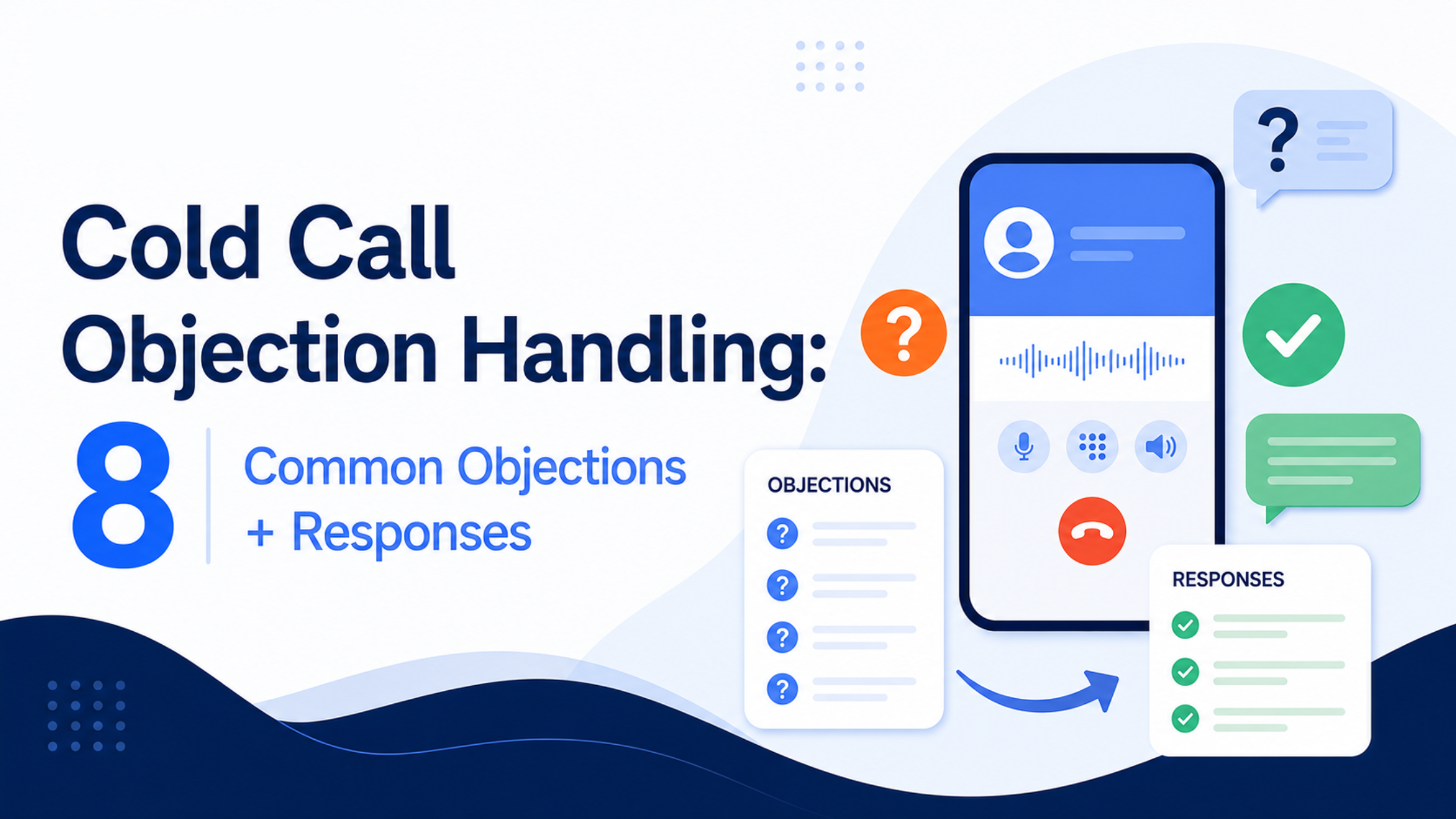
How to Handle Cold Call Objections: The 8 Most Common and What to Say
Cold calling objections are not the problem most sales teams think they are.
The real problem is what happens in three seconds after one land. A rep hears "I'm not interested" and either stumbles through a weak pivot, talks too much, or hangs up. None of those outcomes moves the deal forward.
Objection handling in cold calling is a skill that can be trained. It follows patterns. And when reps know exactly what to say before they pick up the phone, their close rate on initial conversations goes up not because they trick anyone, but because they stop getting rattled by words, they should have already heard a hundred times.
This guide covers the 8 most common cold calling objections, what each one actually signals, and what to say in response. It also covers how Koncert's dialer platform helps reps handle objections better in real time, at scale.
What Are Cold Call Objections?
Cold call objections are statements a prospect makes during an unsolicited outbound call that express resistance, doubt, or disinterest. They range from reflexive brush-offs ("not interested") to genuine concerns ("we already have a tool for that") to timing issues ("call me next quarter").
Most cold calling objections fall into four categories:
-
Timing objections: "Now isn't a good time."
-
Priority objections: "This isn't on our radar right now."
-
Competitor objections: "We already use something for this."
-
Trust or relevance objections: "How did you get my number?" / "I don't see how this applies to us."
Understanding which category an objection falls into is the first step to responding effectively. A timing objection needs a different response than a competitor objection. Treating them the same way is where most reps lose the call.
The 8 Most Common Cold Call Objections and What to Say
Objection 1: "I'm not interested."
What it usually signals: The prospect hasn't heard enough to form a real opinion, or they're conditioned to deflect cold calls by default.
What to say:
"That's fair — you don't have enough information yet to be interested. Can I take 20 seconds to explain why I called specifically, and then you can tell me if it's worth 5 minutes?"
Why this works: You're not pushing back or arguing. You're acknowledging the response while giving them a low-pressure reason to stay on the line. The 20-second framing resets expectations. Most prospects grant it.
What to avoid: Don't say "I understand, but..." It signals you're about to ignore what they said.
Objection 2: "We already have a solution for this."
What it usually signals: The prospect is using something, but that doesn't mean it's working well. This objection is an opening, not a wall.
What to say:
"Totally makes sense. Most of the teams I speak with have something in place. The question I usually ask is: are you getting the connect rates and pipeline you expected from it? If yes, I won't waste your time. If not, it might be worth a 10-minute call."
Why this works: You're not attacking their existing vendor. You're asking a diagnostic question that invites honest reflection. If their current tool is actually working, they'll say so and you've respected their time. If it isn't, they'll often pause and that pause is your opening.
Objection 3: "Now isn't a good time."
What it usually signals: This can mean they're literally busy, or it's a polite brush-off. Your job is to figure out which one without being pushy.
What to say:
"No problem. When would be a better time? I can send a calendar invite right now while I have you."
Why this works: It takes the call off the table immediately (removes pressure) and moves directly to scheduling. Getting a time on the calendar during the call even a tentative one is dramatically more effective than a vague "I'll follow up" promise.
Tip: If they give a vague answer like "next week," narrow it. "Is Tuesday or Thursday better for you?"
Objection 4: "Just send me an email."
What it usually signals: A deflection designed to end the call without a hard no. The email rarely gets read.
What to say:
"Happy to. To make sure it's actually useful and not just another email in your inbox what's the one thing that would make this worth 15 minutes of your time? I'll address that specifically."
Why this works: You're complying with the request while adding a qualifier that re-engages them in the conversation. If they answer the question (and they often do), you now have a real discovery insight to use in the follow-up email and you can reference the call.
Objection 5: "We don't have budget right now."
What it usually signals: Budget is often a proxy for priority. If something is important enough, budget gets found. This objection usually means the prospect doesn't yet see enough value to make it a priority not that money literally doesn't exist.
What to say:
"Completely understand. Budget cycles are tight everywhere right now. Let me ask if budget weren't a factor, is this something you'd want to solve? I ask because it helps me know whether it's worth staying in touch for next cycle or whether this just isn't a fit."
Why this works: It separates the budget issue from the interest issue. If they say "yes, I'd want to solve it," you've confirmed a future opportunity and can set a follow-up for the right time. If they say no, you've saved both sides from a dead-end relationship.
Objection 6: "I'm not the right person. You should talk to [someone else]."
What it usually signals: Either they genuinely aren't the decision maker, or they're redirecting to avoid the conversation. Both are useful information.
What to say:
"Really appreciate you telling me that. Before I reach out to [name/role], can you help me understand is this something your team has been looking at, or would I be starting from scratch with them?"
Why this works: You get two things from this response: a warmer handoff and qualification intel. If the team has already been evaluating solutions, your call to the actual decision maker is much stronger. If they haven't, you know to expect a cold start.
Follow-up move: Ask for an intro email or internal forward. Even a one-line "you should talk to this person" from an internal contact beats a cold outreach.
Objection 7: "How did you get my number?"
What it usually signals: Surprise, mild irritation, or a genuine privacy concern. This one needs a calm, transparent answer. Getting defensive here ends the call.
What to say:
"Good question. Your contact details came through [data source/tool/LinkedIn]. I understand if the timing is off I'm reaching out because [specific, relevant reason related to their role or company]. Happy to answer any questions about that."
Why this works: Transparency disarms the objection faster than anything else. Don't over-explain. Name the source, state your reason for calling, and let the prospect decide where to go from there.
What to avoid: Vague answers like "I found you online" create more suspicion, not less.
Objection 8: "We tried something like this before and it didn't work."
What it usually signals: A past negative experience with a similar product or approach. This is one of the harder cold call objections to handle because it's based on real experience, not a reflexive deflection.
What to say:
"I hear that bad experiences with tools in this space are pretty common, honestly. Can I ask what specifically didn't work? I want to understand whether what we do differently would matter to you or not."
Why this works: You're validating their experience and using it as a discovery question. If they tell you what failed (and they often will), you learn exactly what you need to position against. If the failure was in something Koncert solves directly like call lag, spam flags, or poor connect rates you now have a direct and relevant comparison to make.
Cold Calling Objection Patterns: What High-Performing Reps Do Differently
Reps who handle cold calling objections well share a few consistent habits:
They pause before responding: A two-second pause after an objection signals confidence. It shows the rep isn't rattled. Reps who rush to respond often sound desperate or scripted.
They acknowledge before they answer: Every effective response starts with some form of validation. Not fake empathy, but genuine acknowledgment that the objection makes sense. "That's fair." "I hear that." "Makes sense." One sentence, then move.
They ask rather than tell: The best cold call objection responses often end with a question, not a pitch. Questions keep the prospect talking. Pitches push them toward hanging up.
They track what's working: Reps who log objection types and outcomes even informally improve faster than those who don't. If "budget" objections rarely convert, that's useful data. If "already have a solution" objections convert at a higher rate when handled a certain way, reps should know that.
How Koncert Helps Reps Handle Cold Calling Objections in Real Time
Knowing the right response is one thing. Executing it consistently on a high-volume call day is another. That gap between knowing and doing is where most objection training breaks down.
Koncert's dialer platform directly addresses this gap in three ways.
Remote Coach: Real-Time Objection Coaching Without Interrupting the Call
Koncert's Remote Coach feature lets managers listen to live calls without the prospect of knowing. When a rep hears a tough objection and starts to stumble, the manager can whisper the right response in real time coaching the rep through the objection while the conversation is still happening.
This is objection handling training at its most effective. Not role-play the day before. Not debrief the day after. Actual in-call coaching at the exact moment it matters.
For SDR managers running teams of 10, 20, or 50 reps, this scales in a way that traditional side-by-side coaching never could.
Conversation Intelligence: Find the Objections That Keep Showing Up
Koncert's Conversation Intelligence feature uses AI to scan call recordings and flag objections automatically. Instead of a manager listening to hours of recordings hoping to catch something useful, the system surfaces the calls where specific objections appeared filtered by rep, list, or disposition.
If "we already have a vendor" is showing up in 40% of calls from a particular prospect list, that's a targeting issue, not just a training issue. Koncert's analytics make that visible before the problem compounds.
AI PitchLab: Practice Objection Handling Before the Real Call
Koncert's AI PitchLab gives reps a way to practice cold calling objections before they pick up the phone for real. Reps choose from AI-powered buyer personas a skeptical VP of Sales, a gate-keeping EA, a budget-conscious CFO and run through realistic objection scenarios in a risk-free environment.
New reps who practice objection handling through AI roleplay before their first live calling session ramp faster and retain their training longer. They've already heard "I'm not interested" dozens of times in practice. It doesn't rattle them on a real call.
Caller ID Health: Stop Letting Spam Flags Create Objections Before the Call Starts
One of the most overlooked cold calling objections isn't said out loud it's the prospect of seeing "Spam Likely" and not picking up at all.
Koncert's automated Caller ID Health management continuously monitors which numbers are getting flagged and rotates them out before they damage connect rates. The Heat Map gives managers a real-time view of number usage across the team, so a number doesn't get overused to the point of being burned.
A clean caller ID doesn't guarantee a great call. But a flagged one guarantees fewer calls get answered which means reps never get the chance to handle the objection at all.
AI Parallel Dialer: More Conversations, More Objection Reps
Handling cold call objections is a skill. Like any skill, it improves with volume. Koncert's AI Parallel Dialer connects reps to 150-200+ calls per hour by automatically filtering through voicemails, phone trees, and bad numbers. Reps only pick up when a live person answers.
More live conversations mean more objection practice per hour. A rep using Koncert gets more at-bats in a single session than a rep on manual dial gets in a full week. The improvement of compounds.
Building an Objection Handling Framework for Your Sales Team
Individual rep skill matters. But a consistent team-level approach to cold calling objections is what scales.
Here's a simple framework:
Step 1: Document the top 5 objections your team hears most often. Pull this from call recordings, not memory. The ones reps say they hear most are not always the ones that appear most in the data.
Step 2: Write one tested response for each objection. Keep each response under four sentences. Test multiple versions over 2-4 weeks and track which converts to a next step (call booked, follow-up agreed, referral given).
Step 3: Run objection drills weekly, not just during onboarding. Five minutes at the start of a team call is enough. One objection, multiple reps, one round each. Keep it fast.
Step 4: Use call recordings to celebrate good handling, not just correct bad handling. Reps learn faster from hearing what looks great than from hearing what they did wrong.
Step 5: Update the playbook quarterly. Objection patterns shift as markets change; competitors shift, and your target list evolves. A cold call objection playbook from 18 months ago is not the same playbook you need today.
Conclusion: Better Objection Handling Starts Before the Objection
The reps who handle cold calling objections well are not the ones who think fastest on their feet. They're the ones who've heard every objection before, practiced the response, and have a manager in their corner when it counts.
That combination preparation, practice, and real-time support is exactly what Koncert is built to enable.
If your team is losing calls on objections they should be handling, the fix is not a new script. It's a system: better call volume, better coaching visibility, better data on what's actually happening on the phones.
Koncert gives SDR managers and sales leaders the tools to build that system AI dialing that puts reps in more conversations, Remote Coach that makes in-call coaching possible at scale, and AI PitchLab that turns objection handling from a weakness into a repeatable strength.
Key Takeaways:
-
Most cold call objections are reflexive, not final the first "no" rarely means "never."
-
Each objection type requires a specific response structure, not a generic pivot.
-
Preparation and real-time coaching tools reduce the time reps spend frozen on a call.
-
Koncert's AI dialer and Remote Coach feature give managers visibility into live objections so coaching happens in the moment, not after the damage is done.
Ready to see how Koncert helps your team turn more cold call objections into booked meetings?
Book a 20-minute demo with the Koncert team.
FAQs
What is cold call objection handling?
Cold call objection handling is the process of responding to a prospect's resistance, disinterest, or questions during an unsolicited sales call in a way that keeps the conversation moving toward a next step. It involves acknowledging the objection, asking clarifying questions, and offering a relevant, low-pressure response.
What is the most common cold call objection?
The most common cold calling objection is "I'm not interested." It's typically a reflexive response rather than a considered decision. Reps who treat it as a final answer miss opportunities that a simple, confident acknowledgment and reframe could recover.
What should you say when a prospect says "not interested" on a cold call?
Acknowledge it briefly, then ask for 20 seconds to explain specifically why you called. Most prospects will grant it. Avoid pushing back directly or restating your pitch immediately that signals you weren't listening.
How do you handle the "we already have a vendor" objection?
Ask how it's working. Specifically, whether they're getting the results they expected. This moves the conversation from defending your position to opening an honest diagnostic. If their current solution is performing well, you learn quickly. If it isn't, the prospect often says so.
How can managers help reps handle cold call objections better?
Real-time coaching tools like Koncert's Remote Coach feature let managers listen to live calls and whisper guidance without the prospect hearing. This is more effective than post-call debriefs because the coaching happens in context, not after the moment has passed.
Subscribe to receive more content like this
Related Posts
6 min read
Optimize Enterprise Sales Calling Across Distributed Teams
Sep 16, 2026 by Koncert Marketing