
15 min read

10 Sales Call Best Practices Every SDR Should Know to Book More Meetings
Most SDRs are not losing deals because they lack effort. They're losing them because effort alone doesn't equal results on the phone.
Cold calling in B2B is harder than it was five years ago. Prospects screen numbers they don't recognize. Gatekeepers are trained to deflect. Phone trees buy companies time. And even when someone picks up, you have about eight seconds before they've decided whether this call is worth their time.
That environment rewards SDRs who are prepared, structured, and consistent. The ones hitting quota aren't doing anything exotic. They've built a set of habits that hold up across every call, every list, every day of the quarter.
This guide covers 10 of those habits. Each one is practical, immediately usable, and grounded in what actually works in outbound B2B sales.
Key Takeaways
-
Research every prospect before you dial. Two minutes of prep produces a specific, relevant reason to call that cold openers never match.
-
Write and practice your opener out loud. The first eight seconds determine whether a prospect stays on the line.
-
Use a call framework, not a script. Frameworks keep reps on track without killing the conversation.
-
Handle objections by asking questions first. Most objections are requests for more information, not hard rejections.
-
Follow up with a purpose on every touch. "Just checking in" is not a next step.
-
Use sales dialer software to remove the dead time.AI-powered dialers, clean caller IDs, and verified contact data let reps spend time talking, not waiting.
What Does an SDR Actually Do?
Before the practices, a quick framing note for anyone newer to the role.
Sales Development Representatives handle the front end of the sales funnel. Their job is to prospect, qualify, and book meetings for Account Executives. They're not closing deals. They're starting conversations and deciding which ones are worth advancing.
That means the SDR role is primarily a volume-plus-quality game. High activity rates matter. So does the quality of each interaction. The best SDRs understand both levers and know when to push each one.
What separates a 40-call day from an 80-call day isn't just effort. It's process, preparation, and tooling. What separates an 80-call day from a productive 80-call day is execution on every call that actually connects.
Why Do Sales Call Best Practices Matter for SDRs?
Sales managers often focus on activity metrics: dials, emails, sequences. Those numbers matter, but they don't tell the full story.
Two SDRs can make the same number of calls and produce very different results. The difference is almost always in how they run those calls, not how many they make. SDR cold calling strategies that are structured and repeatable outperform raw volume every time.
Consistent best practices do a few specific things:
-
They reduce decision fatigue. When the opening, questioning, and follow-up process is structured, reps aren't reinventing the wheel on every call.
-
They make coaching faster. When everyone follows the same framework, managers can pinpoint exactly where calls break down, and fix it.
-
They create a feedback loop. Structured calls produce comparable data. That data tells you what's working and what isn't.
-
They compress ramp time. New SDRs who learn the right habits early reach full productivity weeks faster than those who figure it out on their own.
None of this requires a complicated playbook. It requires clear habits, practiced consistently.
What Are the Best Sales Call Practices for SDRs? 10 Techniques That Actually Work
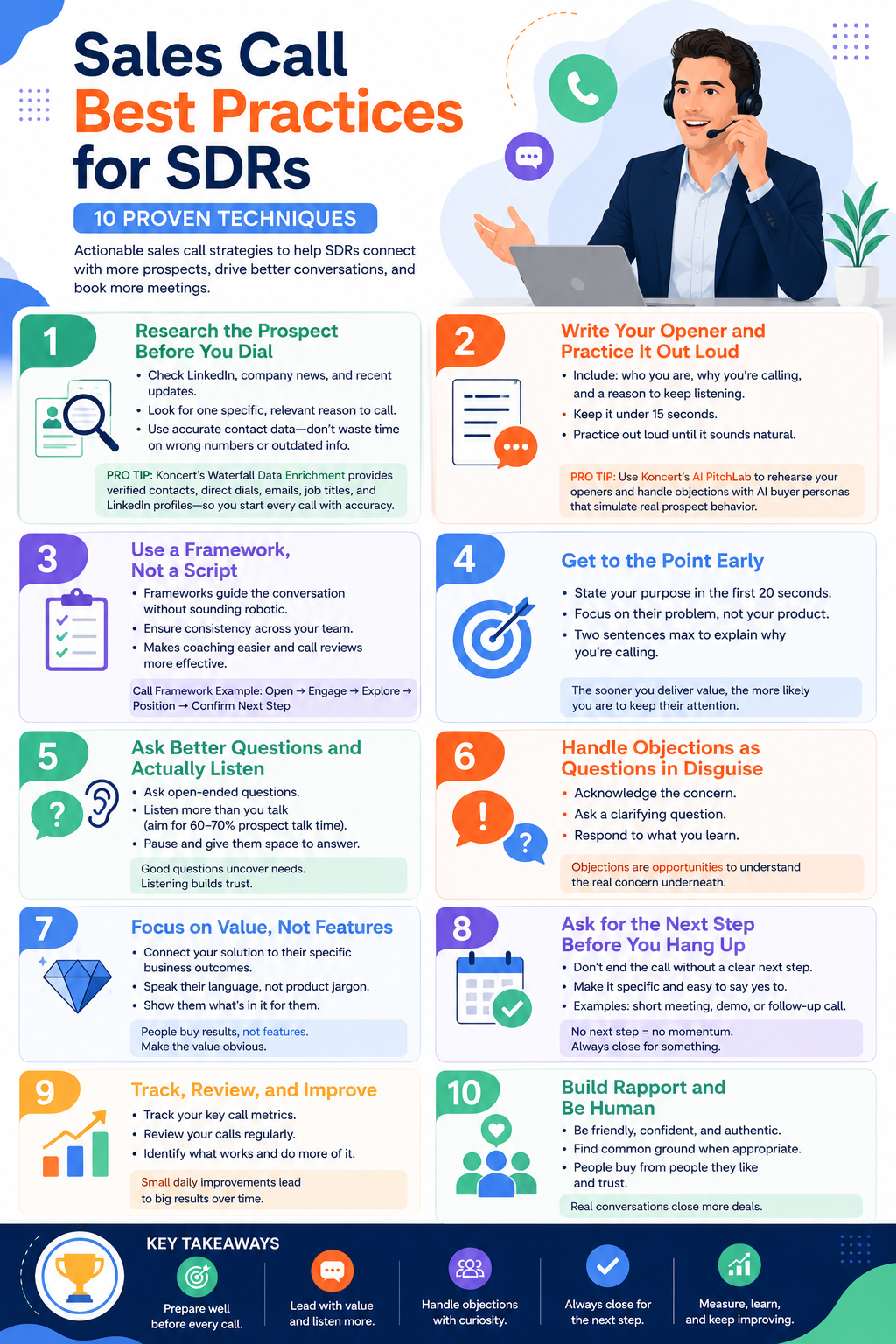
1. Research the Prospect Before You Dial
Two minutes of preparation is enough to change the entire tone of a call.
Before you pick up the phone, check LinkedIn for recent activity, role changes, or posts. Look at the company's news feed for funding announcements, hiring surges, or product launches. Scan your CRM for any prior touchpoints or notes from a colleague.
You're not trying to become an expert on their business. You're looking for one specific, relevant reason to call. That detail is the difference between "Hi, I wanted to introduce my company" and "Hi, I noticed your team added 4 SDRs last quarter. We work with a lot of fast-growing outbound teams, and call activity tends to get harder to manage at that scale. Worth sixty seconds?"
The second opener wins more conversations. Not because it's clever, but because it's specific. Specificity signals that you did the work, and that the call might actually be worth taking.
One thing that undermines prep fast: bad contact data. If a rep spends time researching a prospect only to dial a disconnected number or reach the wrong person because job titles are outdated, that prep time is wasted. Clean, verified contact data is the foundation everything else sits on. Koncert's Waterfall Data Enrichment fills in missing or outdated contact details, including direct dial numbers, job titles, emails, and LinkedIn profiles, by pulling from multiple verified data sources in sequence. If one source doesn't have the data, the next one kicks in. Reps start every session with accurate records instead of burning time on dead ends.
2. Write Your Opener and Practice It Out Loud
Most reps improvise their first ten seconds. That's a mistake.
Your opener is the highest-leverage moment in any cold call. It determines whether the prospect stays on the line. Ad-libbing it, even after hundreds of calls, introduces unnecessary variation and nerves.
Write a short, direct opener. It should include: who you are, why you're calling, and a reason for the prospect to keep listening. It should not pitch the product. It should not include the phrase "I was hoping to connect."
Time your opener. If it runs longer than fifteen seconds, cut it. Then say it out loud, not in your head, until it sounds natural.
A good structure looks like this: "Hi [Name], this is [Your Name] from [Your Company]. I'll be quick. Do you have ninety seconds?"
Adjust the opener for your specific solution and persona. But always write it, and always practice it.
Practicing your opener in isolation only gets you so far. The real test is how it holds up when a prospect interrupts, pushes back immediately, or asks a question you didn't expect. That's where Koncert's AI PitchLab earns its place. Reps can rehearse their openers, talk tracks, and objection responses against AI-powered buyer personas that mimic real prospect behavior, from skeptical CFOs to busy VP of Sales. The simulation is interactive and dynamic, not a static script review. New reps get call-ready faster, and experienced reps can pressure-test new messaging before taking it live.
3. Use a Framework, Not a Script
Scripts make reps sound scripted. Frameworks keep reps on track without removing the conversation.
Teams that run consistent frameworks also get better coaching. When every rep follows the same structure, a manager listening to a call can immediately identify where it went off track. Was the opener weak? Did the rep skip qualification and go straight to pitching? Did they fail to ask for a specific next step? The framework makes that visible.
If you don't have a call framework yet, build one. It takes an afternoon and it will improve your results faster than almost anything else on this list.
4. Get to the Point Early
Prospects aren't waiting for you to warm up. The longer you take to get to the reason for calling, the more time you're giving them to tune out or hang up.
Every extra sentence before your purpose costs you credibility. Prospects know it's a sales call. They don't need five sentences of preamble before you tell them why you're there.
State your purpose in the first twenty seconds. Make it about a problem they might have, not a product you want to sell. If you can't explain why you're calling in two sentences, go back to your pre-call research. The answer is usually there.
5. Ask Better Questions and Actually Listen to the Answers
Asking good questions is a skill. So is shutting up long enough to hear the answers.
Open-ended questions produce useful information.
"What does your current outbound motion look like?" tells you far more than "Are you using a dialer right now?"
"What's your biggest challenge with connect rates this quarter?" opens a real conversation. "Do you have connect rate issues?" closes it.
After you ask, stop. Many reps jump back in within a second or two because silence feels uncomfortable. That silence often means the prospect is thinking. Give them the space to answer fully before you respond.
The talk-to-listen ratio on a good discovery call runs about 30-40% rep, 60-70% prospect. If you're doing most of the talking, you're pitching, not qualifying.
6. Handle Objections as Questions in Disguise
An objection is not a door closing. It's usually a question the prospect hasn't asked directly yet.
"We already have a solution" often means "convince me yours is meaningfully different." "Now isn't a good time" can mean "I haven't heard a compelling reason to prioritize this." Your job is to figure out what's underneath the objection, not just counter the surface statement.
A simple three-step approach works well: acknowledge the concern without agreeing with it, ask a clarifying question, then respond to what you learn.
For example: Prospect says "We're locked into a contract with our current vendor." Instead of pivoting immediately to a feature comparison, try: "That's fair. Out of curiosity, when does that contract come up? And are there specific things you'd want to see improved before you look at renewing?"
That moves the conversation forward without being pushy. And it surfaces information you can use in the follow-up sequence.
The biggest problem with objection handling is that most reps only practice it on live calls, where the cost of getting it wrong is real. AI PitchLab gives SDRs a place to work through the most common objections repeatedly, in a realistic back-and-forth environment, before they encounter them with an actual prospect. Reps who have rehearsed "we already have a tool" or "we don't have budget right now" twenty times respond with confidence instead of hesitation. That confidence comes through on the call.
7. Mind Your Pacing and Tone
Content matters. Delivery matters just as much.
Reps who speak too fast signal nerves or a canned pitch. Reps who speak too slowly lose the prospect's attention. The goal is a natural, conversational pace that matches the energy of the person you're talking to.
Tone is also easy to overlook. A flat delivery drains the energy from even a well-structured call. Vary your emphasis. Slow down on key points. Let your sentences land before moving on.
Record your calls and listen back. Most reps avoid this because it's uncomfortable. That discomfort is the point. You'll catch filler words, trailing sentences, rushed transitions, and habits you didn't know you had. Those are fixable once you can hear them.
8. Close Every Call with a Specific Next Step
Vague endings kill pipeline. "I'll send some information and we'll reconnect" is not a next step.
Every call should end with a clear, mutual commitment: either a meeting is booked on the spot, or there's a defined action with a specific date attached. "I'll send you that case study this afternoon, and let's hold 11am Thursday to discuss it" is a next step. "I'll follow up sometime next week" is not.
When you ask for a meeting, reduce friction. Offer two specific time slots rather than an open-ended ask. The easier you make it to say yes, the more often prospects do.
If the prospect isn't ready to commit, find out what would need to change for them to move forward. That separates a timing objection from a fit issue, and it tells you exactly how to handle the next touch.
9. Follow Up with Purpose, Not Just Persistence
Most conversions in B2B outbound happen after multiple touchpoints. Despite that, many SDRs give up too early, or follow up in ways that add nothing to the conversation.
"Just checking in" is not follow-up. It's noise. Every touch after the first call needs to add something: a relevant piece of content, a reference to something the prospect said, a timely news item about their company or industry, or a new angle that wasn't covered in the first call.
Build a multi-channel cadence that combines calls, emails, and LinkedIn. Vary the timing. A prospect who doesn't answer the phone on Tuesday morning might reply to a LinkedIn message on Wednesday afternoon.
Log everything in your CRM after every call. Notes from the last conversation are the fuel for a better next one. If you don't capture them, you start from zero every time.
10. Use Your Tools to Their Full Potential
There's a ceiling on what effort alone can achieve. At some point, the constraint isn't the rep. It's the process and the tools underneath them. For most B2B outbound teams, the right sales dialer software is the single biggest lever outside of rep execution itself.
AI-powered dialers handle the parts of outbound calling that burn time without producing conversations: voicemails, phone trees, bad numbers, busy signals. When those are filtered automatically, reps spend their time talking to live prospects instead of waiting through rings and recordings.
Caller ID health is one of the most underrated factors in connect rates. A number that shows up as "Spam Risk" on a prospect's screen will go unanswered regardless of how strong the opener is. Platforms that automatically monitor, rotate, and clean caller IDs solve a problem most reps don't know is hurting them until their connect rates drop.
Local presence dialing, where your outbound number matches the area code of the prospect, also makes a consistent difference. People are more likely to answer a call that looks local. Most modern dialers include this, but not all of them manage it well.
Koncert's AI Parallel Dialer, for example, handles voicemail detection, phone tree navigation, local caller ID matching, and caller ID health management automatically. Reps see prospect data the moment a live call connects. Sessions that would take a full day of manual dialing happen in a fraction of the time.
Coaching tools matter too. When managers can listen to live calls, filter recordings by disposition, and coach reps in real time without the prospect hearing, teams improve faster. That feedback loop is hard to replicate without the right infrastructure.
How Should SDRs Adapt Their Approach for Different Buyer Personas?
Not every prospect responds to the same approach. Adjust your delivery based on who you're talking to.
The Busy Executive: Get to the point in the first ten seconds. Lead with business impact and respect their time explicitly. They're not interested in a product tour. They want to know if this is worth thirty more minutes of their time.
The Technical Evaluator: Come prepared with specifics. Expect detailed questions about implementation, integration, and reliability. Don't oversell. Stick to what you can verify.
The Skeptical Prospect: Don't push harder. Ask more questions. Help them articulate the problem themselves. Third-party validation, peer examples, and specific data carry more weight than a confident pitch.
The Relationship Builder: Give the conversation more time. Listen actively. Demonstrating that you understand their situation earns more trust than proving you know your product.
Conclusion: How Koncert Helps SDR Teams Execute Every One of These Practices
The ten practices in this guide work. But executing them consistently, at scale, across a full SDR team is a different challenge than knowing what to do.
That's the gap Koncert is built to close.
Start every session with clean data. Bad contact records waste prep time and drain rep morale. Koncert's Waterfall Data Enrichment replaces missing or outdated contact details, including direct dial numbers, emails, job titles, and LinkedIn profiles, by pulling from multiple verified data sources in real time. If one source can't fill the gap, the next one steps in. Reps start dialing with accurate records, not question marks.
Get more prospects to pick up. Even a perfect opener doesn't matter if no one answers. Koncert's AI Parallel Dialer filters through voicemails, phone trees, and bad numbers automatically, connecting reps only when a live person picks up. Local presence dialing matches outbound numbers to the prospect's area code to improve answer rates. And Koncert's Heat Map monitors caller ID health daily, flagging and rotating spam-marked numbers before they tank a session's connect rate.
Train reps before calls go live. Most reps practice objection handling and openers on real prospects, where mistakes have real consequences. AI PitchLab gives SDRs a structured, on-demand environment to rehearse pitches, work through objections, and sharpen their talk tracks against AI personas that behave like actual buyers. New reps ramp faster. Experienced reps test new messaging without risking a live deal. Teams show up to every call better prepared.
Coach at scale without listening to every call. Koncert's Remote Coach lets managers monitor live calls in real time and use Whisper Mode to coach reps mid-call without the prospect hearing. Call recordings are searchable by rep, disposition, and date. Conversation intelligence scans recordings for objections and patterns, so managers know what to address in coaching sessions without manually reviewing hours of audio.
Keep reps in a rhythm. Koncert's Remote Salesfloor replicates the energy of an in-office call blitz in a virtual environment. Reps can monitor each other's sessions, managers can drop in and observe, and teams can run coordinated call blitzes that build momentum and improve adoption.
Everything syncs bi-directionally with Salesforce, HubSpot, Salesloft, Outreach, and other leading CRMs, so call outcomes, notes, and follow-up tasks are logged automatically. Reps don't spend time on admin. Managers have accurate data for coaching and forecasting.
Koncert is SOC 2 Type II certified, GDPR compliant, and built with features to support TCPA compliance. It has been a G2 High Performer with 400+ reviews and an average rating of 4.6 stars, backed by 15 years of parallel dialer experience and 13 patents.
If your team is doing the right things on calls but still not seeing the results, the infrastructure might be the missing piece.
FAQ: Sales Call Practices
How many calls should an SDR make per day?
Quality and quantity both matter. Top SDRs typically reach 60-80 meaningful dials per day. With AI-assisted dialing, that number can exceed 10x without sacrificing conversation quality. The right target depends on your list quality, industry, and sales motion.
Should I leave voicemails on cold calls?
Yes, but selectively. Voicemails for high-value prospects should be short (under 30 seconds), specific, and include a clear reason to call back. For high-volume sessions, automated voicemail drop saves significant time while keeping the message consistent.
What is the right talk-to-listen ratio on a sales call?
Aim for 30-40% talking on your end, 60-70% listening. If you are past that ratio, you are pitching more than qualifying.
How do I improve cold call connect rates?
Local presence dialing, optimized call timing, clean caller IDs, and AI-powered dialers that filter voicemails and phone trees all move the needle. Fix the infrastructure first, then work on execution. Tools like Koncert's AI Parallel Dialer handle voicemail detection, phone tree navigation, and caller ID health so reps spend time on live conversations.
How many follow-ups should I send before moving on?
Industry benchmarks suggest 8-12 touches across channels before a prospect responds. Most reps give up after one or two. Build a structured multi-channel sales cadence and stick to it.
What is the best sales dialer software for SDR teams?
The best sales dialer for an SDR team depends on call volume, team size, and sales motion. Key features to evaluate are: AI voicemail detection, local presence dialing, automated caller ID health management, CRM integration, and live coaching tools. Koncert's AI Parallel Dialer is built specifically for high-volume B2B outbound teams and handles all of those automatically.
How can SDRs practice cold calls before speaking to real prospects?
Role-playing with a manager or peer helps, but it requires scheduling and availability. Koncert's AI PitchLab lets reps rehearse openers, objection handling, and talk tracks against AI-powered buyer personas on demand, any time, without needing a manager present. New reps use it to get call-ready before their first live session. Experienced reps use it to test new messaging before rolling it out.
See how Koncert helps SDR teams connect more, coach better, and convert faster. Book a demo and we'll walk through what it looks like for your team.