
17 min read
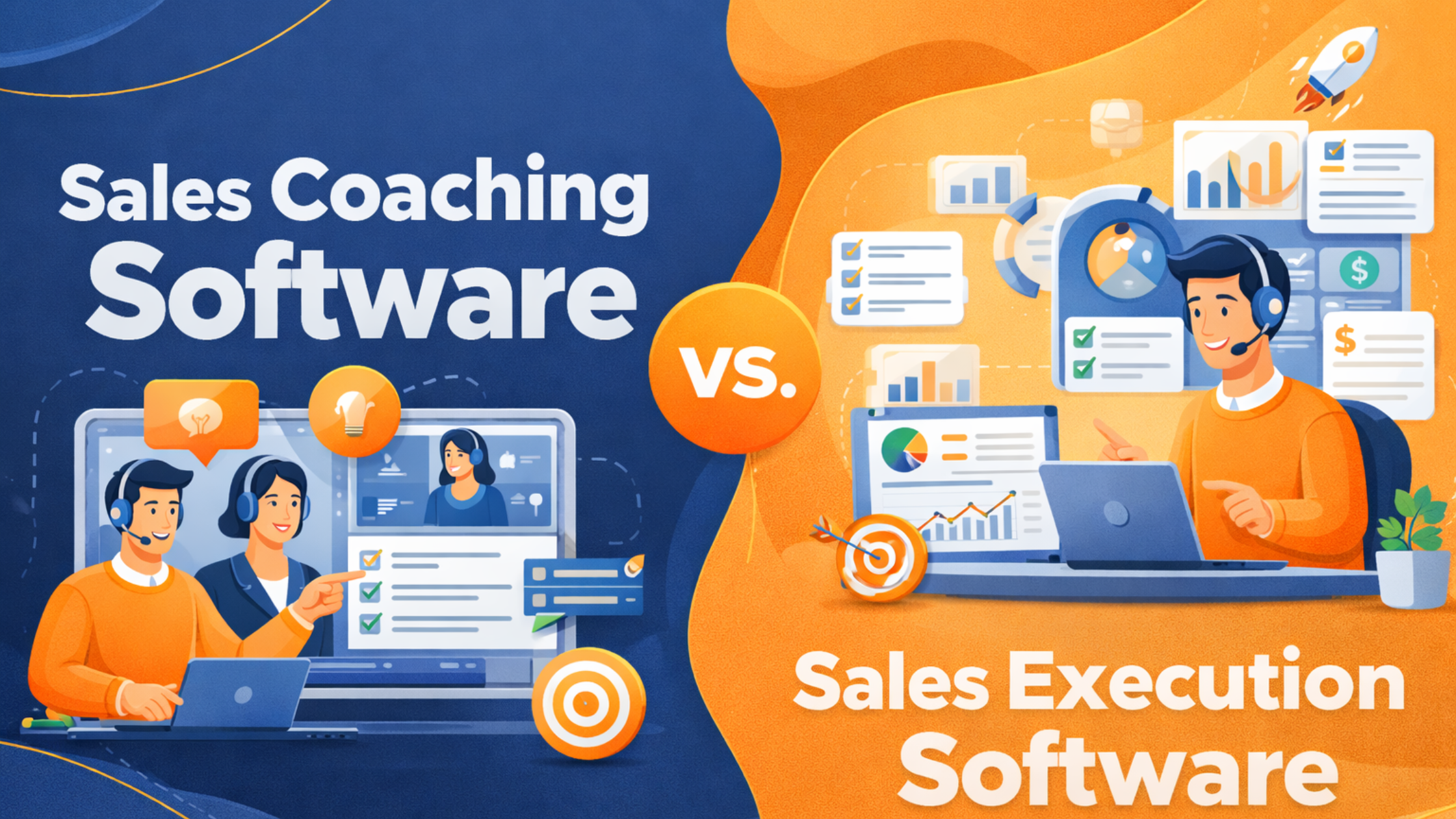
Sales Coaching Software vs. Sales Execution Software: Why Buyers Are Asking the Wrong Question
Every week, revenue leaders evaluate sales coaching software looking for the same thing: a way to make their reps better, faster. They demo platforms that score calls, surface objections, recommend talk tracks, and generate AI-powered feedback. And then they buy one.
Three months later, the coaching scores look great. The pipeline doesn't.
The reason is almost always the same: coaching software can only improve what reps already do. If your reps aren't having enough live conversations to begin with, even the most sophisticated sales coaching software in the world cannot fix your pipeline problem. You are coaching inside a vacuum.
This is the wrong question most B2B sales teams are asking: "Which coaching tool should we buy?" The right question is: "Why aren't our reps getting enough live conversations to coach on in the first place?"
In this post, we break down the real difference between sales coaching software and sales execution software—and why the teams seeing measurable pipeline gains in 2026 are combining both, with Koncert's AI Parallel Dialer and Remote Coach at the center of that stack.
The Real Problem With How Teams Buy Sales Coaching Software
Sales coaching software has become one of the fastest-growing categories in the B2B SaaS market. Vendors are racing to offer AI-powered call scoring, conversation intelligence, objection detection, and rep scorecards. The pitch is compelling: give managers better visibility, and performance will follow.
The assumption is that reps are already generating enough call activity, enough live conversations, and enough raw data for coaching to have something meaningful to work with.
For the majority of outbound B2B sales teams, that assumption is false.
The average outbound SDR manually dials between 40 and 60 numbers per day. Given typical B2B connect rates—often between 4% and 8%—that produces somewhere between 2 and 5 live conversations daily. You cannot build a meaningful coaching program, identify patterns across objections, or improve talk tracks from 2 to 5 data points per rep per day. The sample size is too small. The feedback loop is too slow.
This is the conversation the sales coaching software category is not having. And it's the one Koncert was built to address.
Sales Coaching Software vs. Sales Execution Software: What's the Actual Difference?
Sales Coaching Software
Sales coaching software focuses on improving rep skills and behavior over time through structured feedback tied to observed activity. This category typically includes call recording and transcription, AI-powered call scoring, conversation intelligence, objection tagging, rep scorecards, and manager dashboards. And the feedback is only as good as the record it works from, which is why real-time transcription sits underneath the whole category, turning each live conversation into the accurate written text that scoring, tagging, and conversation intelligence all read from. The output is insight: here is what your rep said, here is how the prospect responded, here is where the call went sideways.
Coaching software is valuable—but it is a downstream solution. It requires activity to analyze. It requires live conversations to score. It is a feedback mechanism, not a production mechanism.
Sales Execution Software
Sales execution software is upstream. It is the infrastructure that determines how many live conversations your reps have in the first place. This category includes AI dialers, local presence technology, caller ID management, voicemail automation, CRM integration, and cadence sequencing tools. The output is volume with quality: more live conversations, connected faster, with the right prospects, using numbers that don't show as spam.
The teams winning in outbound sales in 2026 are not choosing between these two categories. They are running both—and making sure the execution layer is strong enough to feed the coaching layer with meaningful signal.
Why Live Conversation Volume Is the Prerequisite for Coaching ROI
Think about what coaching actually requires. A manager needs to hear enough calls to identify a pattern. They need to observe what a rep says when a CFO pushes back on pricing, when a gatekeeper asks what the call is regarding, when a prospect says 'send me an email.' One or two examples isn't coaching—it's anecdote.
When reps are having 3 live conversations a day, coaching is reactive and slow. When reps are having 15 to 25 live conversations per session—which is what Koncert's AI Parallel Dialer is designed to produce—coaching becomes proactive, pattern-based, and fast.
Volume doesn't just help coaching software work better. Volume is what makes the coaching investment defensible to a CRO or VP of Sales. When you can tie coaching interventions to measurable changes in connect rates, conversation quality, and pipeline output—all within a single platform—the ROI calculation becomes clear.
Caller ID Is a Coaching Problem Too
Here's a coaching problem most sales leaders don't identify as a coaching problem: spam flags.
When your outbound numbers get flagged as spam—which happens quickly when teams dial at volume without proper caller ID management—prospects stop picking up. Connect rates collapse. And now you have a coaching system scoring a rep's performance on calls that were never going to convert, because the prospect saw "Spam Risk" on their screen before they declined.
Koncert's automated Caller ID Health management—including its Heat Map technology—monitors the status of your outbound numbers in real time. When a number starts showing signs of being flagged, it is quarantined automatically. Clean numbers are rotated in from the pool. Your reps never know there was a problem, and your connect rates stay consistent.
Combined with Koncert's Automated Local Presence technology—which automatically matches your outbound caller ID to the area code of the prospect you're calling—this means your reps are calling from numbers that look local, look legitimate, and get answered at meaningfully higher rates.
That is the execution layer working the way it should. And it is the foundation that makes everything downstream—coaching, conversion, pipeline—possible.
How Koncert Bridges Execution and Coaching in a Single Platform
Koncert is not a coaching tool that added a dialer. And it is not a dialer that bolted on a call recording feature. It was built from the ground up to solve both sides of the outbound productivity problem: generating more live conversations, and improving what reps do with those conversations once they happen.
AI Parallel Dialer: The Execution Engine
Koncert's AI Parallel Dialer enables reps to dial multiple lines simultaneously, with AI doing the work of filtering through busy signals, voicemails, phone trees, and bad numbers in real time. When a live human answers, the call is transferred to the rep instantly—with CRM data surfaced on screen before the rep says a word.
The result is a dramatic increase in live conversation volume. Reps using the AI Parallel Dialer typically reach 150 to 200-plus dials per hour, with connect rates ranging from 5% to 15-plus percent depending on list quality and target industry. That is not a marginal improvement over manual dialing. It is a structural transformation of what a rep's day looks like.
Critically, Koncert achieves this without the lag problem that plagues other parallel dialers in the market. Competitors using third-party telephony APIs—platforms built on Twilio or Vonage infrastructure—introduce latency between when a prospect answers and when the rep is connected. That pause costs meetings. Koncert embeds its own phone technology and AI in a single network, eliminating that lag. The prospect hears a real person, immediately.
Remote Coach: The Coaching Engine, Built for Scale
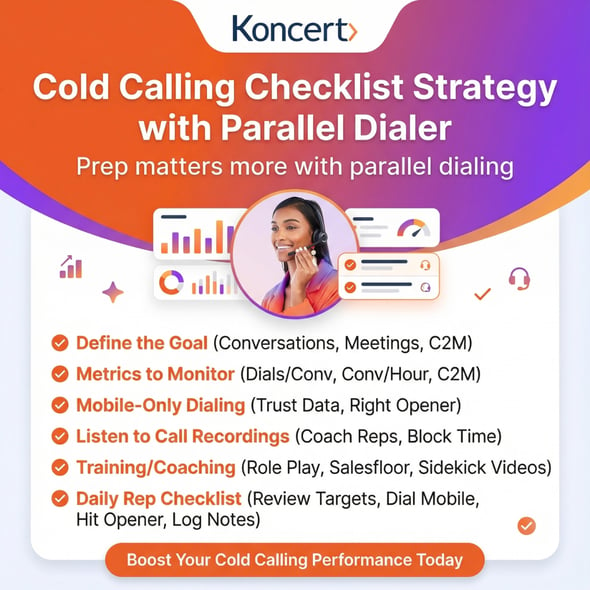
Remote Coach is Koncert's real-time and asynchronous coaching infrastructure. It was designed for the reality that SDR managers are not sitting next to every rep on every call—and that coaching only works if managers can intervene when it matters, not three days later on a recorded call.
During live calls, Remote Coach enables managers to listen in and use Whisper Mode to coach the rep in real time—providing guidance on objection handling, pricing conversations, or next steps—without the prospect hearing a word. This is live coaching at the moment of truth, not feedback delivered after the opportunity has passed.
After calls, managers can filter recordings by rep, day, call disposition, or outcome—making it fast to find the examples that matter. AI-assisted objection detection tags calls where specific objection patterns appear, so managers can address systemic weaknesses across the team rather than coaching one rep at a time.
The call library lets managers save examples of strong calls, tag them, and share them across the team as training references. This creates a coaching asset library that improves over time—reducing the burden on managers to create training content from scratch.
AI PitchLab: Practice Before the Live Call
Coaching after the call is only half the loop. Koncert's AI PitchLab closes the other half: preparation before the call.
AI PitchLab gives reps an on-demand AI roleplay environment where they can practice their pitch against AI personas that behave like real prospects—skeptical CFOs, curious marketing managers, gatekeepers, and decision-makers across industries. Reps can rehearse objection handling, refine their opener, and test different talk tracks without the pressure of a live call.
For new reps, this dramatically compresses ramp time. Instead of learning on live prospects—which costs pipeline and damages first impressions—new hires can get call-ready in a safe environment before their first session begins. For experienced reps, AI PitchLab provides a place to sharpen messaging before launching a new campaign or targeting a new persona.
Remote Salesfloor: The Culture Layer
Coaching doesn't just happen in 1-on-1 feedback sessions. Some of the most effective coaching happens in the shared energy of a call blitz—when junior reps hear experienced reps navigating tough objections in real time, when managers can pop into a session and recognize a win, when the team is calling together and drawing motivation from each other.
Koncert's Remote Salesfloor brings that experience into a virtual environment, enabling distributed and hybrid teams to call together, learn from each other, and build the kind of team culture that improves adoption and sustains motivation over time.
What the Right Stack Looks Like in 2026
The teams generating the most pipeline from outbound in 2026 are not running coaching software on top of a broken execution layer. They have made a deliberate choice to solve both problems—and they have structured their stack accordingly.
The execution layer handles:
-
Generating 150 to 200+ dials per hour with AI Parallel Dialing
-
Keeping caller IDs clean and out of spam filters automatically
-
Matching local presence to prospect area codes for better pickup rates
-
Eliminating time wasted on bad numbers via Parking Lot quarantine
-
Connecting live calls to reps instantly with zero perceptible lag
The coaching layer handles:
-
Real-time whisper coaching during live calls via Remote Coach
-
AI-detected objection patterns across the full team's call library
-
Pre-call rehearsal through AI PitchLab persona simulations
-
Team learning through call library tagging and shared recordings
-
Analytics that link coaching inputs to measurable pipeline outputs
When these two layers are integrated in a single platform—as they are in Koncert—the feedback loop becomes tight. More conversations feed better coaching. Better coaching produces better conversations. And the pipeline impact becomes visible within weeks, not quarters.
Five Questions to Ask Before Buying Sales Coaching Software
If you are currently evaluating outbound sales coaching software or sales execution platforms, use these questions to pressure-test fit before you commit:
-
How many live conversations per day is each of our reps currently having? If the answer is under 10, coaching software is not your first problem.
-
What percentage of our dials are going to voicemail, bad numbers, or spam-flagged outcomes? If you don't know, your execution layer needs attention before your coaching layer.
-
Does the coaching tool we are evaluating generate its own call volume, or does it depend on another platform to produce calls? A coaching tool that depends on a separate, weak dialer will always be limited by that dialer's ceiling.
-
Can our managers coach in real time during live calls, or only after the fact? Post-call feedback is valuable. In-call coaching changes the outcome of that specific conversation.
-
What happens to our caller IDs when our team scales up dialing volume? Spam flagging is a silent killer of outbound programs. Make sure the platform you choose manages it automatically.
How Leading Sales Coaching and Dialer Platforms Compare in 2026
The market for outbound sales software has expanded rapidly, and buyers now have more options than ever across the coaching and execution spectrum. Here is a clear-eyed look at the major platforms in this space, what each does well, and where each one fits in a modern B2B sales stack.
1. Koncert
Koncert is the only ultra-low latency AI dialer platform that combines a full execution engine with integrated coaching tools in a single stack. Its AI Parallel Dialer enables 150–200+ dials per hour, with Quick Connect technology built on a proprietary phone network—not third-party APIs—so there is no lag when a live call connects. Remote Coach gives managers real-time whisper coaching on live calls and pattern-based analysis across recordings. AI PitchLab adds a pre-call practice layer for reps to rehearse against AI personas before ever touching a live prospect. With 15+ years of dialer experience, 13 technology patents, automated Caller ID Health management, and a high G2 rating, Koncert is the strongest choice for outbound teams that want coaching and execution in one place.
Best for: Small, Mid-market and enterprise outbound teams that need high-volume dialing, real-time coaching, and clean caller ID management in one platform.
Integrations: Salesforce, HubSpot, Salesloft, Outreach, Gong, Apollo.io. SOC 2 Type II certified. GDPR and TCPA compliant.
2. Nooks
Nooks positions itself as an AI sales assistant that combines dialing, prospecting, and coaching in one workspace. Its AI Coach can score calls and surface patterns for managers, and its roleplay bot allows reps to practice against simulated prospect conversations. Nooks has invested heavily in the coaching and prospecting narrative, making it appealing to teams that want a modern, AI-forward brand. Where Nooks tends to draw scrutiny from buyers evaluating dialing infrastructure is in the depth of its execution layer—specifically around latency, caller ID health management, and the maturity of its telephony stack relative to purpose-built dialer platforms.
3. Orum
Orum is a live conversation platform built around accelerating connect attempts and getting reps to more live prospects faster. Its AI detection filters voicemails, busy signals, and phone trees, and it provides strong connection performance metrics that managers can use as coaching signals. Its coaching capabilities are primarily activity- and throughput-based, making it a strong fit for SDR teams where the primary coaching lever is dialing discipline and connection volume rather than deeper skill development during live conversations.
4. Salesfinity
Salesfinity is positioned as an AI parallel dialer designed for high-volume outbound teams, with a salesfloor-style environment that supports collaborative calling sessions. Its automated follow-up features add workflow automation to the dialing motion, and activity signals from dialing sessions give managers a basis for coaching conversations. Salesfinity is a relatively newer entrant in the parallel dialing space and tends to appeal to growth-stage teams looking for a modern outbound software.
5. Gong
Gong is one of the most recognized names in the conversation intelligence and revenue intelligence category. It records, transcribes, and analyzes sales calls across the full sales cycle—not just outbound SDR work—and provides managers with AI-powered insights on deal risk, competitor mentions, talk-to-listen ratios, and coaching gaps. Gong is purpose-built for coaching and deal intelligence, not for generating call volume. It requires a separate dialer to produce the calls it analyzes, which means teams running Gong still need a strong execution layer underneath it. At its price point, Gong is typically deployed at the enterprise level across full-cycle AE teams rather than purely for SDR outbound programs.
6. Chorus by ZoomInfo
Gong is one of the most recognized names in the conversation intelligence and revenue intelligence category. It records, transcribes, and analyzes sales calls across the full sales cycle—not just outbound SDR work—and provides managers with AI-powered insights on deal risk, competitor mentions, talk-to-listen ratios, and coaching gaps. Gong is purpose-built for coaching and deal intelligence, not for generating call volume. It requires a separate dialer to produce the calls it analyzes, which means teams running Gong still need a strong execution layer underneath it. At its price point, Gong is typically deployed at the enterprise level across full-cycle AE teams rather than purely for SDR outbound programs.
7. Talkdesk
Talkdesk is a contact center platform with sales-oriented features that include call handling, monitoring, and coaching-adjacent capabilities built into a broader voice infrastructure. For organizations that operate at the intersection of sales and customer support—or that coach inside a telephony environment rather than a pure outbound sales workflow—Talkdesk can provide the call visibility and QA structure managers need. It is less purpose-built for the B2B outbound SDR motion and more suited to mixed sales and support environments that need enterprise-grade telephony with some coaching functionality on top.
8. Convoso
Convoso is a predictive dialer platform built primarily for call center-style outbound environments where the priority is maximizing agent talk time through automation and routing efficiency. Coaching in Convoso is largely performance-based—contact rates, conversion metrics, and agent scorecards—rather than skill-development focused. It is well-suited to high-volume B2C lead generation and insurance or financial services teams that need dialing throughput above all else. For B2B SaaS sales teams focused on consultative outbound selling, Convoso’s call-center DNA may feel like a mismatch.
Stop Optimizing the Wrong Layer
If your outbound pipeline is underperforming, the answer is almost never "more coaching." The answer is almost always "more live conversations, coached better." Those are two different problems that require two different solutions—and the best teams in 2026 are solving both at once.
Koncert is the only ultra-low latency AI dialer built with its own phone network and AI in a single stack—so your reps connect faster, your caller IDs stay clean, and your coaches have the real signal they need to improve performance at scale.
Ready to see what happens when execution and coaching work together? Request a Koncert demo and we'll show you exactly how our AI Parallel Dialer and Remote Coach work as a unified system to move your pipeline.
Frequently Asked Questions
How many conversations per hour can I expect with parallel dialing?
Parallel dialing can significantly increase your conversation volume compared to traditional methods. Your actual results depend on list quality, time of day, industry, and connect rates. AI-powered dialers with ultra-low latency deliver the best results.
What is the difference between sales coaching software and sales execution software?
Sales coaching software focuses on improving rep skills through structured feedback and call analysis—tools like call recording, AI scoring, and objection detection. Sales execution software focuses on generating the raw material coaching depends on: more live conversations, better connect rates, and cleaner caller IDs. The best outbound programs run both layers in a unified platform.
How many live conversations should a rep have per day for coaching to be effective?
There is no universal threshold, but most sales enablement practitioners agree that coaching becomes pattern-based and actionable once reps are having 10 or more live conversations per day. Below that number, the sample size is too small to distinguish skill problems from structural problems like spam-flagged numbers or poor list quality. Koncert's AI Parallel Dialer is designed to help reps reach 15 to 25+ live conversations per calling session.
What is Remote Coach and how does it differ from traditional call recording tools?
Remote Coach is Koncert's real-time and asynchronous sales coaching tool. Unlike traditional call recording platforms that only allow post-call review, Remote Coach enables managers to listen to live calls and use Whisper Mode to coach the rep in real time—without the prospect hearing. Managers can also filter recordings by rep, outcome, or call disposition, and use AI-detected objection tagging to identify team-wide coaching priorities.
Why does caller ID management matter for sales coaching ROI?
When outbound numbers get flagged as spam, prospects stop picking up. This collapses connect rates and means coaching software ends up scoring calls that were never going to convert regardless of rep skill. Koncert's automated Caller ID Health management—including its Heat Map and quarantine workflow—prevents spam flags from silently killing your outbound program, ensuring coaching tools have clean, meaningful data to work with.
What is AI PitchLab and how does it help new SDR ramp times?
AI PitchLab is Koncert's on-demand roleplay environment where reps can practice their pitch against AI personas that simulate real buyer behaviors—from skeptical CFOs to curious marketing managers. New reps can rehearse objection handling, test openers, and refine their talk track before their first live calling session, significantly compressing ramp time without burning live pipeline opportunities.
Is Koncert compliant with GDPR, CCPA, and TCPA regulations?
Yes. Koncert is SOC 2 Type II certified and GDPR compliant. The platform also includes features designed to support TCPA compliance. That said, compliance requirements vary by use case, jurisdiction, and team configuration. Koncert recommends consulting your legal counsel regarding compliance with applicable laws and regulations specific to your organization's outbound calling program.
How does Koncert's AI Parallel Dialer differ from other parallel dialers on the market?
Most parallel dialers are built on top of third-party telephony APIs from providers like Twilio or Vonage, which introduces latency when a live call is connected to a rep. This lag is long enough for prospects to hang up or assume the call is robotic. Koncert embeds its own phone technology and AI in a single, proprietary network, delivering ultra-low latency connects so that when a prospect answers, a real rep is already there. This is one of the key reasons Koncert holds 13 technology patents in the dialer space.
Conclusion: The Category You Buy Determines the Problem You Solve
The sales software market in 2026 offers more options than ever for helping reps improve and managers coach. But the single biggest mistake B2B sales leaders make when building their stack is buying a coaching solution before they have fixed their execution problem.
Coaching software is a feedback mechanism. It scores, analyzes, and surfaces patterns from conversations that have already happened. Its value is real—but it is entirely dependent on a steady, high-quality supply of live conversations to work with. When that supply is thin, coaching software produces thin insights. When your caller IDs are flagged as spam, when your reps are having three conversations a day instead of fifteen, when your dialer introduces lag that causes prospects to hang up—coaching software cannot fix any of that. It can only describe the symptoms.
Sales execution software solves the upstream problem. It determines how many opportunities your reps have to practice, improve, and convert. And the teams that get this right—that invest in a strong execution layer first and layer structured coaching on top of it—are the teams compounding their outbound performance quarter over quarter.
Among all the platforms reviewed in this comparison—Nooks, Orum, Salesfinity, Gong, Chorus, Talkdesk, and Convoso—Koncert is the only platform that was purpose-built to solve both problems simultaneously, inside a single, integrated stack. Its AI Parallel Dialer generates the live conversation volume that makes coaching meaningful. Its Remote Coach delivers real-time and asynchronous coaching precisely when and where it matters. Its AI PitchLab closes the loop with pre-call preparation that turns coaching insights into rep readiness before the next dial session begins.
That is not a marginal difference from competing platforms. It is a structural one. And for B2B sales teams that are serious about outbound performance in 2026, it is the difference that matters most.
If your team is currently evaluating sales coaching software, sales dialers, or both—start with the execution layer. Audit how many live conversations your reps are actually having per day. Check whether your outbound numbers are showing up as spam. Measure the latency between when a prospect answers and when your rep is on the line. Fix those problems first.
Then layer coaching on top of a dialing engine that can feed it. That is the stack that builds pipeline. And that is what Koncert was built to deliver.
📞 See Koncert in Action
Book a personalized demo and see how Koncert’s AI Parallel Dialer and Remote Coach work together to multiply live conversations and accelerate rep development—in a single platform built for B2B outbound teams.