
13 min read
Business Phone System vs. Sales Calling Platform: What's the Difference?
A business phone system and a sales calling platform both handle inbound and outbound calls, but they solve different problems. A business phone system is built for general communication: dial tone, voicemail, call routing, and business numbers for the whole company. A sales calling platform is built for revenue teams. It connects every call to your CRM, records and analyzes conversations, manages caller ID reputation, and folds calling into sales workflows so reps sell more and log less.
The short version: if calling is how your team makes money, a general phone system leaves value on the table. This guide breaks down what each one does, where traditional phone systems fall short for sales, the features to look for, and how to decide which fits your team.
What Is a Business Phone System?
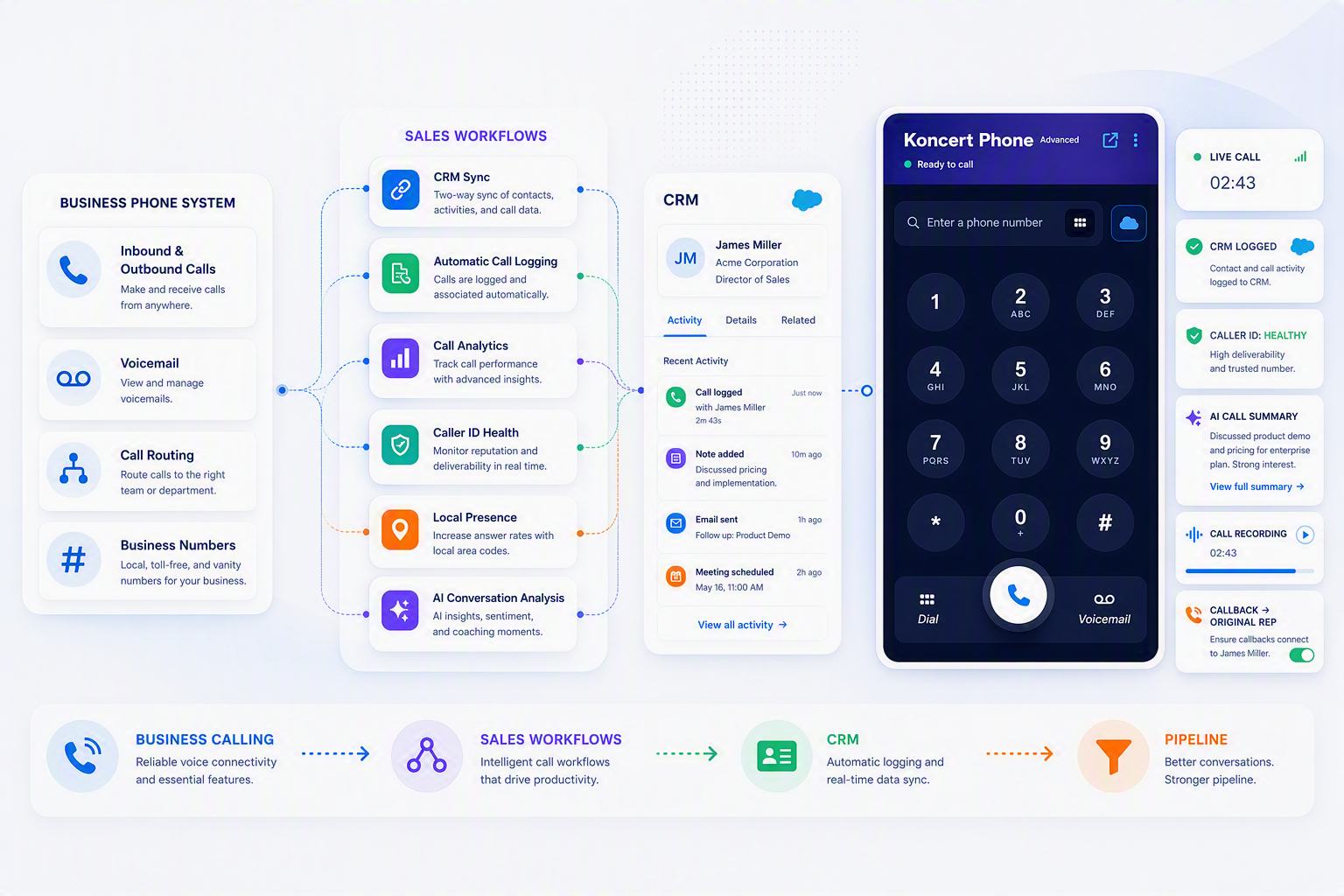
A business phone system is the calling backbone for an organization. Modern versions are cloud phone systems, using VoIP to replace on-site PBX hardware. The core capabilities cover general communication for the whole company:
-
Inbound and outbound calling across the organization.
-
Voicemail with mailboxes per user or department.
-
Call routing through auto-attendants, extensions, and ring groups.
-
Business numbers for teams, departments, and individual staff.
It answers one question well: can everyone in the company make and receive calls reliably? Support, reception, operations, and some sales all run on it. What a business phone system usually does not do is connect those calls to sales data or workflows. A call happens, and unless a rep writes it down, no record reaches the CRM. That gap is where sales teams start to feel the limits.
What Is a Sales Calling Platform?
A sales calling platform is built around how revenue teams actually work. Calling is the starting point, not the whole product. Alongside inbound and outbound calls, it adds the data and workflow capabilities that turn calls into sales activity:
-
CRM and SEP integration with two-way sync to Salesforce, HubSpot, Salesloft, Outreach, and more.
-
Automated call logging that writes every call, note, disposition, and recording to the CRM without manual entry.
-
Call recordings and analytics covering connect rates, talk time, and call volume by rep and by list.
-
Sales workflows like click-to-dial, cadence steps, and dispositioning tied to next actions.
-
Caller ID management including local presence dialing and reputation monitoring to protect connect rates.
-
Conversation intelligence that transcribes calls and generates AI summaries so managers can coach at scale.
The purpose is different. A business phone system asks whether people can call. A sales calling platform asks whether calling is producing pipeline, and gives managers the data to improve it. If you want the fundamentals of the cloud calling layer underneath, see our guide to cloud phone systems for sales teams.
Business Phone System vs. Sales Calling Platform: A Side-by-Side Comparison
The clearest way to see the difference is feature by feature. Here is how the two stack up:
|
Capability |
Business phone system |
Sales calling platform |
|
Inbound & outbound calling |
Yes |
Yes |
|
CRM integration |
Rare or paid add-on |
Native, two-way |
|
Automatic call logging |
Manual entry |
Automatic |
|
Call analytics |
Basic call volume |
Connect rate, talk time, by rep |
|
Call recording |
Sometimes |
Standard, with transcription |
|
Caller ID management |
Not managed |
Monitored and remediated |
|
Local presence dialing |
No |
Yes |
|
Click-to-dial in CRM |
No |
Yes |
|
Callback routing |
General line |
Back to the original rep |
|
AI conversation analysis |
No |
Yes |
Both make and take calls. Everything after that first row is where a sales calling platform pulls ahead for revenue teams.
Where Traditional Business Phone Systems Fall Short for Sales Teams
A general phone system is not a bad product. It is built for a different job. For a sales team, the gaps add up:
-
Manual CRM updates: Reps retype call outcomes, details get missed, and pipeline data drifts out of date.
-
Disconnected tools: The phone lives in one place, the CRM in another, and the sequencer in a third, so reps spend the day toggling.
-
Limited sales analytics: You see total call volume, but not connect rate or talk time by rep, so managers cannot spot what is working.
-
Caller ID challenges: Numbers get flagged as spam and no one manages the reputation, so connect rates quietly fall.
-
Missed callbacks: A returned call hits a general line and never reaches the rep who made the original dial.
-
Limited workflow integration: No click-to-dial, no cadence steps, and no dispositioning tied to the next action.
Each gap is small on its own. Together they cost a sales team conversations and clean data every single day.
What Should Sales Teams Look for in a Calling Platform?
When you evaluate options, look for the capabilities that turn calls into revenue activity:
Three things have shrunk the advantage over the past few years:
-
CRM and SEP integration with two-way sync
-
Call analytics: connect rate, talk time, and volume by rep and list.
-
Call recording and transcription for coaching and compliance.
-
Managed caller ID health that monitors reputation and clears spam flags
-
Local presence dialing to raise answer rates
-
DID and custom caller ID options for different call types
-
Callback routing back to the original rep
-
Click-to-dial directly inside the CRM
-
AI conversation analysis with automatic call summaries
-
Unlimited calling and fast, hardware-free setup
Two questions cut through most vendor pitches. Does it log to your CRM without manual steps, and does it manage caller ID reputation for you? If either answer is no, expect hidden costs in rep time and lost connects.
How Koncert Phone Combines Business Calling With Sales Workflows
Koncert Phone is a cloud phone system built for revenue teams. It gives you the reliable business calling of a phone system and the sales capabilities of a calling platform in one place, fully integrated with the Koncert Platform. Reps get set up in minutes through a Chrome extension, with unlimited calling, no hardware, and no per-minute fees.:
Integrated With the Koncert Platform
Unlike standalone VoIP providers, Koncert Phone is part of the wider Koncert Platform. Calls and conversations flow into Koncert Analytics and Call Recordings automatically, so managers get one view of performance, outcomes, and coaching moments.
Fully Managed Caller ID Health
Koncert actively monitors your caller ID reputation, resolves spam flags, and maintains number health so more of your calls get answered. This includes the DID numbers you create inside Koncert Phone.
Callback Connection Technology
When a prospect misses a call from a Koncert dialer and calls back later, Koncert Phone routes the call straight to the rep who made the original dial. Fewer missed opportunities, and no confusion over who reached out.
Automatic CRM and SEP Activity Logging
Every call, note, disposition, and recording syncs automatically to Salesforce, HubSpot, Microsoft Dynamics, Salesloft, Outreach, Apollo, and Gong, which removes manual data entry and keeps pipeline data accurate.
Salesforce Click-to-Dial
With the Koncert Phone Advanced subscription, Salesforce users launch calls with a single click from inside Salesforce and keep every Koncert Phone calling capability, without leaving the CRM.
Call Analytics
Managers see call volume, connect rates, and talk time across every rep in real time, and can drill down to a specific rep or list to find issues and opportunities.
AI Conversation Intelligence
Every call is recorded and transcribed, then turned into a concise AI call summary that syncs to your CRM. An AI coaching add-on surfaces the talk tracks that win.
Time Zone Restrictions and Quick Access
Time zone controls keep reps calling within business hours, and quick links put recordings, analytics, and CRM contact search a click away. Koncert Phone comes in a base plan and a Koncert Phone Advanced plan that adds Salesforce Click-to-Dial, AI-powered Sales Insights and Coaching, personalized onboarding, and a phone support line.
How Koncert Phone Works With Koncert's Dialers
Koncert Phone is one part of the wider Koncert Platform. Teams that run high-volume outbound pair the cloud phone system with Koncert's four dialers, so the same numbers, analytics, and recordings carry across every tool:
-
AI Parallel Dialer places 150 to 200-plus calls per hour by dialing multiple prospects at once and connecting reps only to live answers. Connect rates run from 5 percent to 15 percent and above, depending on the list, industry, and persona.
-
AI Power Dialer runs single-line dialing at 60 to 80 calls per hour, filtering out voicemails, busy tones, and phone trees.
-
Agent-Assisted Dialer uses trained human dialing agents to navigate gatekeepers and IVRs, then hands live prospects to reps.
-
Click Dialer places one-click calls directly inside Salesforce or a cadence.
A few platform features keep those dialers productive:
-
Caller ID Heat Map tracks how often each number is used and warns managers before a number risks a spam flag.
-
Quick Connect removes the lag when a parallel call connects, so reps start the conversation without an awkward pause. fills missing phone numbers and contact fields from multiple verified providers, so local presence has good numbers to dial.
-
Waterfall Data Enrichment fills missing phone numbers and contact fields from multiple verified providers.
-
Remote Coach and Remote Salesfloor let managers monitor live calls, coach reps, and run virtual call blitzes.
The connection is the point. A prospect dialed through the AI Parallel Dialer who calls back later routes straight to the rep's Koncert Phone through Callback Connection Technology. Recordings and connect-rate data from every dialer feed the same Koncert Analytics, so reps prospect at volume and manage ongoing conversations from one platform instead of a stack of disconnected tools.
Which Is Right for Your Team?
Use this as a quick gut check.
A business phone system may be enough if:
-
General communication is the main requirement
-
Calling volume is relatively low
-
Sales workflow integration is not essential
A sales calling platform is the better fit if:
-
Calling is central to revenue generation
-
Reps work heavily inside a CRM or sales engagement platform
-
Managers need visibility into calls and outcomes
-
Caller ID reputation and connect rates matter
-
Teams want sales-specific productivity features
Most revenue teams land on the second list. Koncert Phone is built for exactly that case, and because it combines both, you do not have to run a separate business phone system and sales calling tool side by side.
Frequently Asked Questions
What is the difference between a business phone system and a sales calling platform?
A business phone system handles general company communication: calling, voicemail, routing, and business numbers. A sales calling platform adds the data and workflow features revenue teams need, including CRM logging, call analytics, caller ID management, and conversation intelligence.
Can a sales calling platform replace a business phone system?
Yes, for sales and revenue teams. A platform like Koncert Phone provides full business calling, including DID numbers, voicemail, unlimited minutes, and call forwarding, plus the sales capabilities a general phone system lacks, so it can serve as both.
What features should a sales team look for in a phone system?
Prioritize CRM and SEP integration, automatic call logging, call analytics, recording and transcription, managed caller ID health, local presence dialing, callback routing, and click-to-dial inside the CRM.
Does a sales calling platform integrate with Salesforce?
A good one does. Koncert Phone syncs activity to Salesforce automatically, and the Advanced plan adds Salesforce Click-to-Dial so reps launch calls without leaving the CRM. It also integrates with HubSpot, Microsoft Dynamics, Salesloft, Outreach, Apollo, and Gong.
What is Caller ID Health?
Caller ID Health is the practice of monitoring your phone numbers' reputation and clearing spam flags so more calls get answered. Koncert's Fully Managed Caller ID Health monitors numbers, quarantines flagged ones, and restores them to a healthy state automatically.
What is Local Presence dialing?
Local presence dialing shows the prospect a caller ID that matches their area code, which raises the odds they answer. Koncert selects local numbers automatically across its dialers and Koncert Phone.
Conclusion
A business phone system and a sales calling platform can look similar on the surface, since both make and take calls. The difference shows up in everything around the call. A business phone system is built for communication. A sales calling platform is built for communication plus the workflows, data, and caller ID management that turn calls into pipeline.
If calling drives your revenue, the platform wins. Koncert Phone gives you both in one place: reliable business telephony, automatic CRM and SEP logging, Fully Managed Caller ID Health, local presence, call analytics, recordings, and AI-powered conversation intelligence, all inside the Koncert Platform.
See Koncert Phone in Action
Book a demo and see how Koncert Phone combines business calling, CRM and SEP logging, Fully Managed Caller ID Health, analytics, and AI conversation intelligence in a single platform.
Key Takeaways
-
A business phone system is built for general company communication: calling, voicemail, routing, and business numbers.
-
A sales calling platform is built for revenue teams. It connects calling to the CRM, records and analyzes conversations, manages caller ID reputation, and folds calling into sales workflows.
-
The gap that matters most for sales is automatic CRM logging, caller ID health, and call analytics, which a general phone system usually lacks.
-
If calling is how your team generates revenue, a general phone system leaves conversations and clean data on the table.
-
Koncert Phone combines reliable business calling with sales capabilities in one platform, so teams do not run a separate phone system and sales tool.