
13 min read
Local Presence Dialing: Does It Really Increase Cold Call Connect Rates?
Yes, local presence dialing usually increases cold call connect rates. Prospects answer numbers that share their area code more often than out-of-state numbers, because a local call could be their doctor, a school, or a neighbor. But the lift is not automatic. It depends on how clean your numbers are, how often you rotate them, and whether carriers have flagged them. A local number marked "Spam Likely" performs worse than an honest out-of-area number.
This guide explains what local presence dialing is, how it works, how it compares to DID and custom Caller IDs, and whether the connect-rate boost is real. It also covers the risks of misusing local numbers, how to manage a Caller ID pool, and how Koncert keeps local numbers healthy so the lift holds up over time.
What is Local Presence Dialing?
Local presence dialing is an outbound calling method where the Caller ID a prospect sees matches their local area code. Instead of a rep in Boston showing a 617 number to a prospect in Denver, the dialer displays a 303 number. The call looks local, which raises the chance the prospect picks up.
The reasoning is straightforward. People answer local numbers more often because a local call feels familiar and low-risk. An unknown out-of-state number reads as a telemarketer and goes to voicemail. Local presence borrows the trust that a local number already carries.
You will also see local presence called local Caller ID or local number dialing. It is standard in most sales dialers today, so the edge is smaller than it once was. It still helps, but only when the numbers behind it are healthy. If you want the fundamentals of the calls these numbers support, pair this with your cold calling and objection-handling guide.
How Does Local Presence Dialing Works?
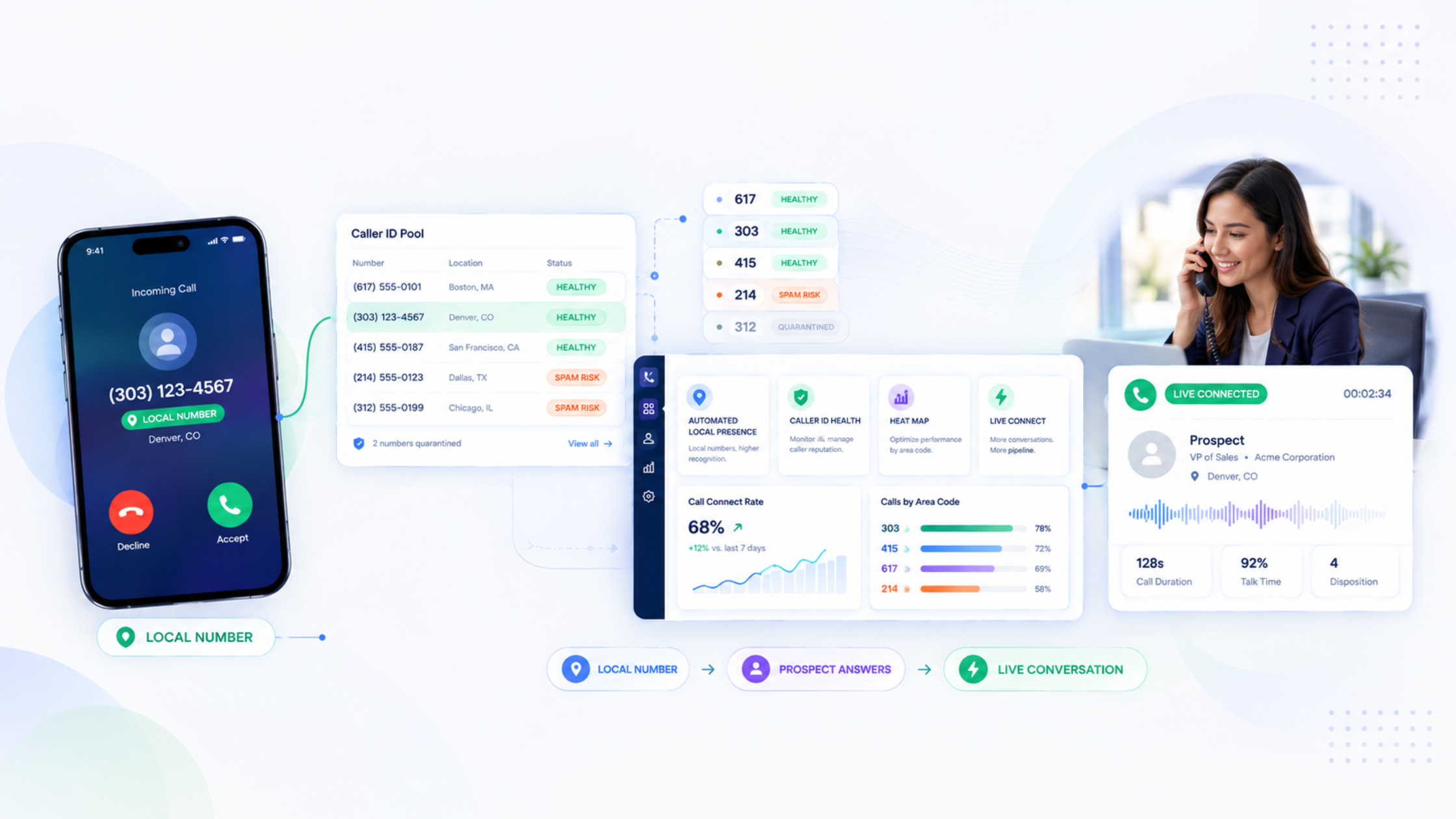
A local presence system keeps a pool of phone numbers spread across many area codes. When a rep dials a prospect, the software reads the prospect's area code and picks a matching number from the pool to show as the outbound Caller ID.
Here is the sequence:
-
The system holds a pool of numbers across many area codes.
-
A rep loads a call list and starts a dialing session.
-
For each prospect, the software reads the area code and selects a matching local number.
-
That local number displays as the Caller ID on the prospect's phone.
-
If the prospect calls back, the system routes the callback to the rep who made the original call.
The rep does nothing extra. They dial as usual, and the area-code matching happens automatically. The piece most teams overlook is that last step. If a prospect returns a call to a local number and it rings into a void, you lose the conversation you worked to create. A system that routes callbacks to the original rep captures that engagement instead of wasting it.
Local Presence Vs. DID Numbers: What is the Difference?
A DID, or direct inward dial, is a dedicated business number assigned to a single rep. It is the rep's own line, the same on every call. Local presence numbers are shared from a pool and rotate based on the prospect's location. Here is how they compare:
|
Factor |
Local presence number |
DID number |
|
Ownership |
Shared pool, rotates per call |
Assigned to one rep |
|
What the prospect sees |
A number local to them |
The rep's consistent number |
|
Best for |
Cold outbound to new prospects |
Warm follow-ups and known contacts |
|
Consistency |
Changes by area code |
Same number every time |
|
Callback handling |
Routed back to the rep |
Rings the rep directly |
You do not have to choose one. Local presence wins the first cold connect. A DID builds recognition once a relationship starts. A prospect you have spoken with three times should see the same number, not a rotating one, so switching that contact to a rep's DID makes the next call feel expected instead of cold.
Local Presence Vs Custom Caller ID
Custom Caller ID lets you display a specific number you choose, such as your main office line or a rep's real direct line. You add your team's numbers to the system, and that exact number shows to the recipient. Unlike local presence, a custom Caller ID does not change by area code. It stays fixed, which makes it useful when the number itself carries trust.
Here is a simple way to decide which to use:
-
Local presence: High-volume cold outbound where raising the answer rate is the goal.
-
Custom Caller ID: Calls where a recognized office number earns trust, such as reaching existing customers or reactivating past accounts.
-
DID: A consistent personal line for ongoing relationships and scheduled follow-ups.
Strong calling programs mix all three and match the Caller identity to the purpose of the call, rather than defaulting to one setting for everything.
Does Local Presence Dialing Actually Improve Connect Rates?
Usually yes, but the size of the boost is smaller and more fragile than many vendors claim. It helps because of familiarity. A local number reads as safe, so more prospects pick up. That effect is real and well documented across outbound teams.
Three things have shrunk the advantage over the past few years:
-
Everyone uses it. Prospects have learned that a local number can still be a sales call, so the surprise factor has faded.
-
Spam labeling. Carriers and call-authentication standards like STIR/SHAKEN can flag pooled numbers. Once your local number shows as "Spam Likely," the benefit reverses.
-
Overuse. Hammer a small pool of numbers and they degrade fast, which trains carriers to flag them.
So local presence improves connect rates when your numbers are clean and unflagged, when you rotate them before they get overused, and when you pair the tactic with active Caller ID health management. It can quietly hurt you when you burn through a small pool, when you never monitor number reputation, or when prospects feel misled.
Be careful with headline statistics. Published estimates of the lift vary widely and depend heavily on list quality, industry, and persona, so a single percentage rarely transfers to your team. As a real reference point, Koncert's AI Parallel Dialer sees connect rates from 5 percent to 15 percent and above, depending on the list, industry, and persona. The mechanism matters more than any one number: a clean local number that a prospect trusts will always beat a flagged one, no matter what the average says.
What are the Risks of Misusing Local Numbers?
Local presence is a tool, and like any tool it can be misused. The main risks:
Spam flagging
Overuse a number and carriers mark it as spam. Once flagged, connect rates drop and the number needs remediation or replacement. A pool that is too small for your dial volume gets flagged fastest.
Compliance exposure
Caller ID practices sit under regulatory and carrier scrutiny. STIR/SHAKEN authenticates Caller ID, and rules exist around deceptive display of numbers, recording consent, and outbound calling under the TCPA. Display only numbers you are authorized to use, keep clear records, and confirm your approach with your legal team. This article is general information, not legal advice.
Trust erosion
If prospects feel tricked by a local number that turns out to be a cold sales call, your brand takes the hit. Use local presence to raise the odds of a real conversation, not to disguise who is calling.
Wasted spend
Buying numbers you burn through in weeks is money down the drain. Right-size the pool and manage it so numbers last.
How Should Sales Teams Can Manage Their Caller ID Pools?
Getting real value from local presence is an operational habit, not a one-time setup. Follow these practices:
-
Size the pool to your volume. Too few numbers means each one gets overused and flagged quickly.
-
Monitor usage and reputation. Track how often each number dials and whether it has been flagged.
-
Rotate before numbers degrade. Retire numbers approaching overuse instead of waiting for a spam flag.
-
Quarantine flagged numbers. Pull them from rotation until their reputation recovers.
-
Keep healthy replacements ready. Have fresh numbers on hand so dialing never stalls.
-
Route callbacks. Send returned calls to the rep who made the original call.
Done by hand, this is a tedious job that teams tend to neglect until connect rates fall. Automating it is what keeps local presence working month after month.
How Koncert Combines Local Presence with Fully Managed Caller ID Health
Local presence only pays off when the numbers behind it stay clean. Koncert automates the full cycle, from selecting the local number to spotting a flag and restoring the number, so reps keep dialing and managers stop babysitting phone numbers.
Automated Local Presence
Local Caller IDs are selected automatically based on the prospect's area code. This works across all four Koncert dialers, the AI Parallel Dialer, AI Power Dialer, Agent-Assisted Dialer, and Click Dialer, as well as Koncert Phone. Reps dial as normal with no extra steps.
Caller ID Heat Map
The Heat Map monitors daily usage of every number and warns managers before a number is overused and at risk of a spam flag. A 30-day view shows which numbers are getting hot so you can retire them before they burn out.
Fully Managed Caller ID Health
Using Koncert's Device Cloud, the platform scans how your Caller IDs appear on real mobile phones and identifies flagged spam numbers. Flagged numbers are quarantined in-app automatically. Koncert's managed services team then works to restore them to a healthy state, and once they are clean, the platform returns them to the dialing pool on its own. Reps never have to manage this by hand.
Parking Lot
Parking Lot quarantines bad and dead numbers using workflow rules, so reps stop wasting dials on disconnected lines and old fax machines and focus on numbers that can actually connect.
Callback Routing with Koncert Phone
When a prospect returns a call that started from a Koncert dialer, Koncert Phone routes it straight back to the rep who made the original call. The engagement you created through local presence turns into a live conversation instead of a missed opportunity.
Flexible Caller ID Options
Beyond automated local presence, Koncert supports a random option that shuffles through numbers from a chosen area code or state, custom Caller IDs using your own team numbers, and a personal DID for each user. You match the caller identity to the call.
How Local Presence Fits into Koncert's Outbound Platform
Local presence is one part of a larger calling platform. Teams that want more conversations pair healthy local numbers with Koncert's dialers and coaching tools:
-
AI Parallel Dialer places 150 to 200-plus calls per hour by dialing multiple prospects at once and connecting reps only to live answers.
-
AI Power Dialer runs single-line dialing at 60 to 80 calls per hour, filtering out voicemails, busy tones, and phone trees.
-
Agent-Assisted Dialer uses trained human dialing agents to navigate gatekeepers and IVRs, then hands live prospects to reps.
-
Quick Connect removes the lag when a parallel call connects, so reps start the conversation without an awkward pause.
-
ZigZag Dialing avoids ringing all of a contact's numbers at once, which protects the prospect experience and your number reputation.
-
Waterfall Data Enrichment fills missing phone numbers and contact fields from multiple verified providers, so local presence has good numbers to dial.
-
Remote Coach and Remote Salesfloor let managers monitor live calls, coach reps, and run virtual call blitzes.
The value is in the connection. Local presence gets the pickup, the dialers create volume, Fully Managed Caller ID Health keeps the numbers alive, and Koncert Phone catches the callbacks. It runs as one system instead of a stack of disconnected tools.
FAQs
Does local presence dialing increase answer rates?
Usually yes. Prospects answer numbers that match their area code more often than out-of-state numbers. The lift depends on keeping your numbers clean and unflagged. A local number marked as spam performs worse than a normal out-of-area number.
Is local presence dialing legal?
Local presence dialing is widely used in B2B sales, but Caller ID display, recording consent, and outbound calling are governed by rules such as STIR/SHAKEN and the TCPA. Use only numbers you are authorized to display and confirm your practices with your legal team. This is general information, not legal advice.
What is the difference between local presence and a DID?
A DID is a fixed number assigned to one rep and is the same on every call. Local presence numbers rotate from a shared pool to match each prospect's area code. Use local presence for cold outbound and a DID for warm, ongoing relationships.
Can local presence numbers get flagged as spam?
Yes. Overused or poorly managed numbers get flagged by carriers, which erases the connect-rate benefit. This is why active Caller ID health management matters. Koncert's Heat Map and Device Cloud monitor numbers and restore flagged ones automatically.
How many local numbers does a sales team need?
It depends on dial volume. A pool that is too small gets overused and flagged fast. Size the pool to your daily dials, rotate numbers before they degrade, and keep healthy replacements ready.
Does Koncert include local presence in all its dialers?
Yes. Automated Local Presence works across all four Koncert dialers, the AI Parallel Dialer, AI Power Dialer, Agent-Assisted Dialer, and Click Dialer, and in Koncert Phone.
Conclusion
Local presence dialing does increase cold call connect rates, but not on its own. The tactic only works when the numbers behind it stay healthy. Flag a number and the local advantage disappears. That is why the teams who win with local presence treat Caller ID management as an ongoing discipline, not a checkbox during setup.
Koncert brings the two together. Automated Local Presence gets the pickup, and Fully Managed Caller ID Health, the Heat Map, and a managed services team keep your numbers clean so the lift holds up over time. Add the dialers and Koncert Phone, and you have one platform that raises answer rates, protects your numbers, and catches the callbacks.
See Local Presence and Fully Managed Caller ID Health working together.
Book a demo and watch how Koncert selects local numbers, spots spam flags before they cost you, and restores numbers automatically, so your connect rate stays high.
Key Takeaways
-
Local presence dialing shows the prospect a Caller ID that matches their area code, which raises the odds they answer a cold call.
-
It usually improves connect rates, but the lift is smaller than it was five years ago and disappears once a number gets flagged as spam.
-
Local presence numbers rotate from a shared pool. DID numbers stay assigned to one rep. Custom Caller IDs display a specific number you choose. The best teams use all three by call type.
-
The real work is managing your Caller ID pool: monitoring usage, rotating numbers before they degrade, and quarantining flagged ones.
-
Koncert automates that cycle by pairing Automated Local Presence with Fully Managed Caller ID Health, a Heat Map, and a managed services team that restores flagged numbers.